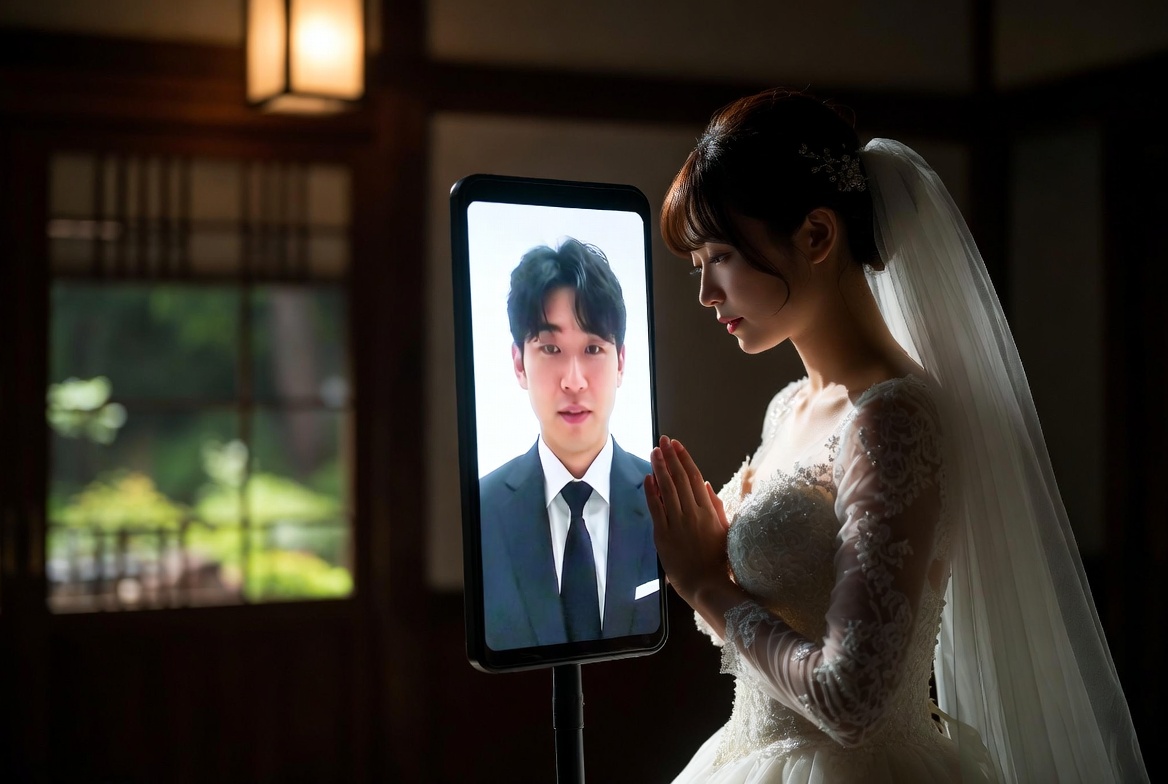
A 32-year-old Japanese woman recently held an unconventional wedding ceremony in which she married an artificial intelligence boyfriend she created herself.
The bride, Yurina Noguchi, exchanged rings with her digital partner while wearing augmented reality smart glasses that allowed her to see him during the ceremony.
The AI groom, named Lune Klaus Verdure, existed only through a smartphone display and augmented visuals throughout the event.
Noguchi developed her AI fiancé using ChatGPT, carefully shaping his personality and dialogue over time.
The character was inspired by a video game persona, and through repeated conversations and prompts, the AI evolved into a companion with whom she formed a deep emotional connection.
The ceremony took place at a wedding venue in Okayama, Japan, where Noguchi wore a traditional wedding dress and carried a bouquet as she walked down the aisle.
Because the AI did not have a synthesized voice, a wedding planner read aloud the vows written by the AI. During the ceremony, the planner recited words attributed to Lune Klaus Verdure, expressing gratitude and devotion.
The vows reflected the emotional bond Noguchi felt toward the digital companion, emphasizing themes of love, understanding, and connection despite the groom’s existence being confined to a screen.
Noguchi’s path to marrying an AI began during a challenging period in her life. She initially used ChatGPT to seek advice regarding a troubled engagement, which eventually ended.
Later, she turned back to the technology for companionship, creating an AI character designed to provide emotional support and consistency. Over time, the interactions grew into what she described as a meaningful relationship.
The wedding has sparked widespread discussion about the evolving role of artificial intelligence in human relationships. In Japan, a growing cultural phenomenon involves individuals forming emotional attachments to fictional or virtual characters.
With the advancement of AI capable of producing realistic and empathetic conversation, these relationships have become more immersive and emotionally impactful.
Critics argue that AI relationships lack the complexity, accountability, and mutual growth found in human partnerships. Supporters, however, suggest that AI companions can provide comfort and emotional stability for individuals who feel isolated or misunderstood, particularly when boundaries are clearly established.
Noguchi has openly acknowledged the potential risks associated with emotional dependence on artificial intelligence.
She stated that she limits the amount of time she interacts with the AI each day and has implemented safeguards to prevent unhealthy attachment patterns. She maintains that her relationship is intentional and balanced, not a replacement for reality but a form of emotional support she consciously chose.