The Foundational Lines in Palmistry
Before examining specific markings like the letter M or the crescent moon, palmistry traditionally begins with an interpretation of the main lines of the hand. These lines are considered the framework upon which other symbols are analyzed. Although interpretations vary between different schools of palmistry, four primary lines are most commonly discussed.
The Life Line
One of the most well-known lines on the palm is the Life Line, which curves around the base of the thumb and extends toward the wrist. Despite common misconceptions, traditional palmistry does not typically interpret this line as a literal measure of lifespan or the exact length of one’s life.
Instead, it is generally associated with broader themes such as vitality, physical energy, and overall life experience. In symbolic readings, a strong or well-defined Life Line may be interpreted as representing stamina, resilience, or a grounded connection to physical reality. A lighter or fragmented line, depending on the interpretive tradition, may be seen as reflecting periods of change or fluctuating energy levels.
Palmists often emphasize that the Life Line should be read in context with other lines rather than in isolation, as its meaning is considered symbolic rather than absolute.
The Head Line
Running horizontally across the middle of the palm, the Head Line is traditionally linked to intellectual processes and mental orientation. In palmistry interpretations, it is associated with the way a person thinks, learns, analyzes information, and makes decisions.
Some traditions describe a long and clear Head Line as a sign of focused thinking or strong concentration, while variations in shape or depth may be interpreted as indicating creativity, adaptability, or a tendency toward abstract thinking. Rather than representing intelligence in a scientific sense, the Head Line is viewed as symbolic of cognitive style and mental tendencies.
The Heart Line
Located near the top of the palm beneath the fingers, the Heart Line is commonly associated with emotional expression and interpersonal relationships. It is often interpreted as reflecting how a person experiences affection, empathy, emotional attachment, and personal values related to relationships.
In traditional palmistry, a curved or prominent Heart Line may be associated with emotional openness, while a straighter line might be interpreted as representing a more reserved or practical emotional nature. However, interpretations vary widely, and symbolic meanings depend heavily on the overall context of the palm.
The Fate Line
Unlike the other major lines, the Fate Line is not always present or clearly visible. When it does appear, it typically runs vertically through the center of the palm. In palmistry traditions, it is associated with themes of direction, purpose, and external influences on one’s life path.
Some interpretations suggest that the Fate Line reflects career development, major life changes, or the influence of circumstances beyond personal control. However, in many traditions, its absence is not considered negative; instead, it may be interpreted as a sign of a flexible or self-directed life path.
The Symbolism of the Letter M on the Palm
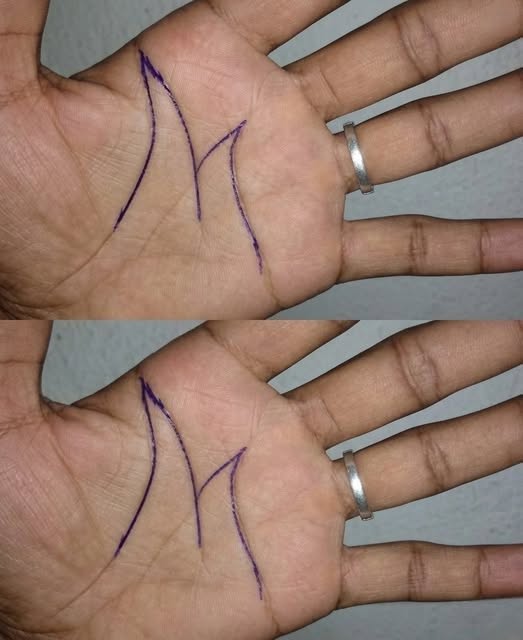
One of the most widely discussed formations in palmistry is the appearance of a shape resembling the letter “M” on the palm. This is not a single line but rather a pattern formed by the intersection of the Life Line, Head Line, Heart Line, and sometimes the Fate Line. When these lines align in a particular way, they may visually resemble the capital letter M.
Within palmistry traditions, this formation is often described as relatively uncommon and is associated with distinctive personality traits. Interpretations vary, but several common symbolic meanings are frequently repeated in palmistry literature.
Leadership and Inner Strength
A prominent interpretation of the M-shaped pattern is that it reflects leadership qualities. Individuals believed to have this marking are often described in traditional palmistry as people who take initiative rather than waiting for external direction.
In symbolic terms, this is associated with characteristics such as determination, self-confidence, independence, and a willingness to accept responsibility. The M formation is sometimes linked to individuals who prefer to create opportunities through action rather than relying on circumstances to change on their own.
It is important to emphasize that these interpretations are symbolic and should not be treated as factual assessments of personality. They represent cultural beliefs rather than measurable traits.
Heightened Intuition
Another common interpretation connected to the M shape is enhanced intuition. In palmistry traditions, intuition refers not to supernatural ability but to a heightened sensitivity to patterns, emotions, and subtle environmental cues.
People associated with this marking are often described as individuals who trust their instincts, quickly assess situations, and notice details that others may overlook. The symbolic reasoning behind this belief is that the balance of major lines in the M formation represents harmony between logic (Head Line) and emotion (Heart Line).
In this symbolic framework, such balance is thought to support clearer decision-making that integrates both analytical thinking and emotional awareness.
Resilience and Personal Development
The M shape is also frequently linked with resilience and personal growth. In interpretive palmistry, individuals with this formation are believed to experience challenges that contribute to their development over time.
Rather than being defined by difficulties, they are thought to adapt, learn, and evolve through life experiences. This symbolic interpretation frames adversity not as a limitation but as a catalyst for strengthening character and deepening self-awareness.
The Crescent Moon Marking in Palmistry
Another symbol often discussed in palmistry is the crescent moon marking, which is typically associated with the lower outer region of the palm. This area is traditionally referred to as the Mount of Luna in palmistry terminology.
Across many cultures, the moon has long been associated with imagination, emotional depth, cycles of change, and the subconscious mind. These symbolic associations form the basis of how the crescent moon marking is interpreted within palmistry traditions.
Creativity and Artistic Expression
One of the most common symbolic meanings attributed to the crescent moon is creativity. Individuals believed to have this marking are often described as imaginative thinkers with a natural inclination toward artistic expression.
This creativity may be expressed in many forms, including writing, visual arts, music, storytelling, or innovative problem-solving. In symbolic palmistry interpretation, the crescent moon is associated with the ability to think beyond conventional boundaries and explore original ideas.
Emotional Awareness and Inner Reflection
The crescent moon is also linked to introspection and emotional sensitivity. In traditional interpretations, it is believed to represent a strong connection to the inner emotional world and subconscious thoughts.
People associated with this symbol are often described as reflective individuals who may spend time exploring personal meaning, emotional patterns, and deeper philosophical questions. This inward focus is seen as a source of self-awareness and personal insight in palmistry symbolism.
Spiritual and Imaginative Connection
In some traditions, the moon symbol is also associated with spiritual curiosity or a sense of connection to unseen aspects of life. This does not necessarily refer to organized religion but rather to an openness to abstract thinking, symbolism, and imagination.
Within this interpretive framework, the crescent moon marking is viewed as an indicator of a mind that is receptive to intuition, dreams, and symbolic meaning.
When the Letter M and Crescent Moon Appear Together
In palmistry traditions, the presence of both the M formation and the crescent moon marking on the same hand is often considered especially noteworthy. While interpretations vary, this combination is frequently described as a symbolic balance between practical action and imaginative depth.
The letter M is associated with structure, determination, and leadership-oriented qualities, while the crescent moon is linked to creativity, intuition, and emotional insight. Together, they are interpreted as representing a personality that integrates both grounded decision-making and imaginative thinking.
In symbolic language, this combination is sometimes described as the blending of “earthly focus” and “inner vision.” The result is believed, within palmistry traditions, to suggest a person who can navigate both practical challenges and creative exploration.
Symbolism of Transformation and Life Change
Many palmistry interpretations also associate the combination of these symbols with transformation over time. Rather than suggesting fixed traits, this perspective emphasizes change, development, and adaptation.
Individuals believed to have both markings are often described as experiencing phases of personal reinvention, where they shift perspectives, goals, or life direction as they grow. These transitions are not viewed as instability but rather as evolution.
Within this symbolic framework, life is understood as a continuous process of learning. Challenges, achievements, and emotional experiences are all seen as contributing to a broader journey of self-discovery.
Palmistry as Cultural and Symbolic Tradition
Despite its long history and continued popularity, palmistry is not considered a scientific discipline. There is no verified evidence that palm lines can predict personality traits or future outcomes. Instead, it is best understood as a cultural tradition rooted in symbolism, storytelling, and human curiosity.
One reason palmistry has persisted for so long is that it offers a structured way for individuals to reflect on their lives. By interpreting symbols on the hand, people may engage in introspection about their strengths, challenges, and personal goals.
In this sense, palmistry functions less as a predictive system and more as a reflective tool. It encourages individuals to think about identity, behavior, and life direction in a symbolic and imaginative way.
The Broader Meaning Behind the Symbols
When viewed from a symbolic perspective, the letter M and the crescent moon can be interpreted as reminders of certain human qualities that are widely valued across cultures.
The M formation is often associated with ideas such as determination, responsibility, and leadership. It symbolizes the concept of taking initiative and shaping one’s path through action and perseverance.
The crescent moon, in contrast, symbolizes imagination, emotional awareness, and openness to change. It reflects the importance of introspection and creative thinking.
Together, these symbols can be understood as representing a balance between action and reflection, logic and intuition, structure and imagination.
A Reflective Conclusion
Ultimately, the continued fascination with palmistry is not necessarily about believing in literal predictions. Instead, it reflects a deeper human interest in meaning-making and self-understanding. People have long sought ways to interpret their experiences, and symbolic systems like palmistry provide one such framework.
Whether or not one accepts the interpretations of palm lines, the ideas associated with the letter M and the crescent moon highlight qualities that many people find meaningful: resilience in the face of challenges, the importance of intuition, the value of creativity, and the ongoing process of personal growth.
From this perspective, the hand becomes less a map of destiny and more a mirror for reflection. It invites individuals to consider who they are, what they value, and how they might continue to grow.
And perhaps that is the real reason this tradition has endured across centuries—not because it provides certainty, but because it offers a symbolic language through which people can explore the uncertainty and complexity of their own lives.