A dog’s relationship with its human companion is built on much more than feeding, walking, and playing. Dogs have lived alongside people for thousands of years, gradually becoming remarkably skilled at understanding human emotions, body language, routines, and even subtle changes in behavior. Sometimes, a simple moment captured in a photograph can reveal just how strong that connection can be.
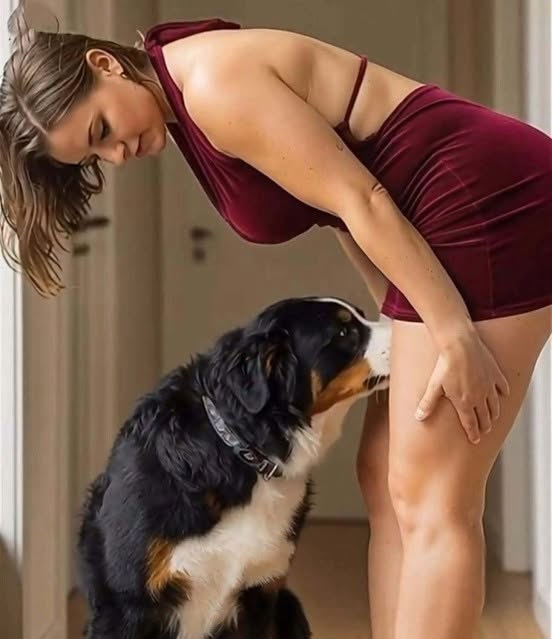
The image shows a woman leaning toward a large, beautiful dog while the animal looks attentively in her direction. At first glance, it may seem like an ordinary interaction between a pet and its owner. However, moments like this can tell us a great deal about how dogs communicate and how they build relationships with the people around them.
Dogs do not communicate with words. Instead, they rely on body position, facial expressions, eye contact, sounds, movement, and physical proximity. When a dog looks closely at a familiar person, it may be paying attention to what that person is doing, anticipating what might happen next, or simply enjoying being near someone it trusts.
Dogs Pay Attention to Human Body Language
One of the most fascinating characteristics of dogs is their ability to observe people. A dog can quickly learn that certain human movements are connected to specific events.
For example, picking up a leash may mean that a walk is coming. Opening a particular cabinet might mean that food or treats are about to appear. Putting on shoes could signal that the owner is preparing to leave the house.
Over time, dogs become excellent observers of these patterns.
In the photograph, the dog appears focused on the woman as she bends down. Its attention is directed toward her rather than toward the surrounding environment. This kind of attention is common when dogs are interacting with familiar people. They often watch our movements because they have learned that human actions contain useful information.
This does not necessarily mean that every unusual movement has a specific meaning. Sometimes a dog is simply curious. Other times, it may be responding to a familiar person approaching its space.
A strong relationship between a dog and its owner rarely develops overnight. Trust is usually created through hundreds or thousands of ordinary experiences.
A dog learns that its human provides food, safety, companionship, comfort, and routine. The owner learns the dog’s habits, preferences, moods, and personality.
These repeated interactions create familiarity.
For a dog, familiarity can be extremely important. A consistent routine can help an animal feel secure because it knows what to expect. Regular meals, exercise, rest, playtime, and positive interaction can all contribute to a stable environment.
Trust can also be demonstrated through proximity. A dog that willingly stays near a person may simply feel comfortable around them. Many dogs enjoy following their owners from one room to another, sitting beside them, or waiting nearby while they complete everyday activities.
Eye contact between humans and dogs can have different meanings depending on the circumstances.
A relaxed dog looking at its owner may be seeking attention or waiting for a signal. It could also be watching for an invitation to play, go outside, or receive affection.
Dogs can also use eye contact when they are uncertain. If something unfamiliar happens, a dog may look toward its owner to understand how the situation should be interpreted.
This is one reason calm human behavior is important around pets. Dogs often notice changes in our tone of voice, posture, and movement. A relaxed owner can sometimes help a nervous dog feel more secure.
However, it is important to remember that individual dogs are different. Eye contact should always be considered together with the animal’s overall body language.
Dog communication involves much more than the eyes.
The position of the ears, tail, mouth, head, and body can provide important clues. A relaxed dog may have a loose body and natural posture. A dog that is frightened or uncomfortable may become tense, lower its body, move away, tuck its tail, or avoid interaction.
A wagging tail does not always mean that a dog is happy. Tail movement can indicate excitement, uncertainty, alertness, or other emotional states depending on the rest of the body language.
This is why responsible dog owners should learn to observe the entire animal rather than interpreting one movement in isolation.
The dog in the photograph appears attentive and engaged with the woman. Its posture suggests that it is focused on the interaction. However, a single photograph cannot tell us exactly what the animal is thinking or feeling. Understanding dogs requires observing their behavior over time and considering the circumstances surrounding each interaction.
Many dogs enjoy physical affection, but every animal has individual preferences.
Some dogs love being petted, hugged, or sitting close to their owners. Others prefer having a little more personal space. Even a friendly dog may become uncomfortable if someone moves suddenly, touches sensitive areas, or approaches it while it is eating or resting.
Learning a dog’s boundaries is an important part of responsible ownership.
Owners should pay attention to signs of discomfort. Turning the head away, licking the lips repeatedly, yawning when not tired, freezing, attempting to move away, or showing other signs of tension can indicate that a dog wants more space.
Respecting those signals helps strengthen trust rather than weakening it.
One of the best ways to build a healthy relationship with a dog is through positive experiences.
Training sessions, walks, games, and calm moments together can all strengthen communication. Positive reinforcement can help dogs understand which behaviors are encouraged without relying on fear or intimidation.
Simple activities can be surprisingly meaningful. A short walk around the neighborhood gives a dog opportunities to explore smells and sounds. A game of fetch provides exercise and mental stimulation. Even sitting together quietly can become part of a familiar routine.
Dogs often value consistency more than elaborate gestures.
For many people, a dog becomes an important member of the household. The relationship can involve companionship, responsibility, patience, and mutual understanding.
The photograph captures a small moment within that larger relationship. A woman and her dog are sharing a simple interaction, but behind such moments can be years of familiarity and trust.
The most meaningful part of living with a dog is often found in ordinary situations rather than dramatic ones. Waiting by the door, following someone through the house, greeting them after a long day, sitting beside them during a quiet evening, or watching them prepare for a walk can all become memorable parts of life together.
Ultimately, the bond between humans and dogs is built through communication. We may not speak the same language, but dogs are remarkably capable of learning our routines and reading our behavior. In return, people can learn to understand the signals dogs use to express comfort, curiosity, excitement, uncertainty, and affection.
A photograph may capture only one second, but that second can represent something much larger: the everyday connection between a person and an animal that has learned to trust them.
And sometimes, the simplest interaction between a dog and its human companion is enough to remind us why dogs have earned such a special place in our homes and in our lives.