Sophie asked if my phone could hear her when nobody was calling. I was turning a pancake, and I nearly folded it in half.
“Can it hear you if nobody called?” she asked again.
“No,” I said. “Not if there isn’t a call.” I set the spatula down and looked at her. “What made you ask?”
She pulled one foot up onto her chair. One sock had blue and yellow stripes, and the other was plain white. She had dressed herself before I got up, which explained the socks but not the question.
“Does yours have to ring first?” she asked.
“It does if somebody calls me.” I picked up my phone from the counter. “See? Nobody’s calling now.”
Sophie watched the screen. Her pancake sat in front of her with a little square of butter melting on top. She had asked for butter on the side the last time, so I reached for her plate.
“Leave it,” she said.
I left it where it was. The kitchen clock said 8:10, and the second pancake was ready to turn.
“Want to help me test it?” I asked.
She nodded once. I held the phone between us and said, “Good morning, telephone. Sophie has two different socks on.”
“That’s because you washed the other ones,” she said.
“Then the washing machine is responsible.” I waited for her smile. It came, but she kept watching the phone.
I checked the screen and turned it toward her. “It didn’t call anyone. It didn’t send anything I said.”
“What if it’s somebody else’s phone?”
“Same answer,” I said. “It has to be on a call for the person at the other end to hear you.” I put mine back on the counter, face up.
Sophie caught her cuff between two fingers. “What if it doesn’t ring?”
I opened my mouth, then closed it. “Are you asking about a call you had?”
She shook her head and slid her chair back just enough to look under the table. Her school folder was on the floor beside her backpack, a spelling sheet sticking out of it.
“That belongs in your bag,” I said.
“I’ll get it later.” She put her foot down and tucked it under the chair.
I carried the second pancake to the table and sat across from her. The butter on hers had melted, but she hadn’t cut a piece.
“You don’t want pancakes today?”
She looked at her plate and then at the counter, where my phone lay. “Do we have oatmeal?”
“Yes. I’ll make you some.” She gave me a nod, and I got up for the saucepan.
When I turned back, Sophie’s fork lay clean beside the pancake.
I filled the saucepan with water and set it on the stove. Sophie watched me open the oatmeal canister.
“Can I have the blue bowl?” she asked.
“Yes. The one with the chip?”
She nodded, and I took it down from the shelf.
On Monday at six thirty, Sophie emptied her school folder onto the kitchen table while dinner warmed in the oven. A spelling sheet slid beneath my hand.
Most of the page was filled with practice words. Across the bottom, in smaller letters, she had written, “Grown-up business stays there.”
“Did your teacher ask you to write this?” I asked.
Sophie shook her head. She put a stack of papers on top of the spelling sheet, then pulled one corner free.
“I thought that meant I wasn’t supposed to tell,” she said.
“Tell who?”
She moved the stack again. “I can’t find my pencil.”
The yellow pencil had rolled under her chair. I picked it up and held it out, but Sophie was looking at the oven timer.
“Three minutes,” I said. “You can draw a whole picture before dinner.”
“Not a good one.”
“Then draw a bad one. I make excellent crooked cats.”
She gave me a small smile and took the pencil. I uncovered the spelling sheet and read the sentence again.
I had told her that arguments about the schedule were grown-up business. Grant and I could settle pickup times without sending messages through her. I had thought those words would make her day easier.
“Did I say you couldn’t tell me about something?” I asked.
Sophie drew a circle on the back of a paper. “You said it stays there.”
“I meant the arguing about days and times. You can always talk to me.”
She added two ears to the circle. “Where’s the blue crayon?”
“In the basket.” I pushed it toward her, and she colored one ear blue. The oven timer rang before she started the other.
When I brought dinner to the table, Sophie touched her cheek. “My mouth is sore,” she said.
“Does it hurt when you eat?”
She looked at her plate. “Can I have the soft part?”
“Yes.” I cut a piece for her and moved the rest to my own plate. She ate slowly while I found the dentist’s number on my phone.
The office was still open. I put the call on speaker, and the receptionist offered Wednesday at four twenty.
“We can be there,” I said. “What’s the copay?”
“Twenty-five dollars.”
I wrote the time on an appointment card from the drawer. Sophie had turned her paper over and was filling in the second ear.
“Is that a cat?” I asked.
“It’s yours. See how crooked?”
I took the spelling sheet off the stack and put it beside the appointment card, instead of in the recycling.
Sophie reached for her pencil again, then turned it around and erased a mark that was not there.
“Will the dentist have to pull one?” she asked.
“I don’t know. The dentist will look first.”
She laid the pencil across her paper. “Will you stay?”
“Yes. I’ll be right beside you.”
On Wednesday, I took leave from work and paid the $25 copay before we were called back. At 4:20, Sophie climbed into the dental chair while I took the seat beside it.
The dentist lowered the light and asked Sophie to open wide. She did, holding both hands flat on the arms of the chair.
“She left her pancake on Sunday,” I said. “Could she have a broken tooth?”
“I’ll take a look,” the dentist said.
Sophie watched the light move overhead. “It looks like a spaceship.”
“Does it?” the dentist asked. “I’ve been trying to find the steering wheel.”
Sophie smiled for a second, then opened her mouth again. The dentist checked each side and asked if any tooth hurt when touched. Sophie shook her head.
“My mouth is sore,” she said.
“Where does it feel sore?” the dentist asked.
Sophie pointed, then let her hand fall into her lap. The dentist looked once more and moved the light aside.
“I don’t see a tooth that needs treatment today,” the dentist said.
“So it isn’t a broken tooth?” I asked.
“I don’t see one. If the soreness continues, call us back.”
The dentist left and returned with a printed finding. I read the line saying no tooth needed treatment, then folded the page carefully and put it in my purse.
Sophie sat up and looked at me. “Can I have oatmeal again?”
“Yes,” I said. “We can have it for supper if you want.”
At the desk outside the exam room, I took out my phone to check the time. A message from Grant had arrived while we were inside: “You’re overreacting. She’s fine.”
Sophie had stopped at a basket of toothbrushes, deciding between blue and green. I opened a new message to Grant and typed, “The dentist didn’t find a broken tooth. Sophie says her mouth is sore.”
I looked at the words before sending them. At pickup, I had seen Owen’s boots beside Grant’s front door. Grant had told me before that his brother was around to help, but I wanted an answer I could keep.
“Is Owen ever left responsible for Sophie without you there?” I added. Then I pressed send.
“Green,” Sophie said, bringing the toothbrush over for me to see.
“Good choice.” I put my phone beside the printed finding while she tucked the toothbrush into her pocket.
The message showed as delivered. Grant had not answered.
Sophie held out her hand for the paper. I folded it small enough to fit in her pocket beside the toothbrush.
“Can I show Dad?” she asked.
“Yes. You can show him.”
The next evening, at 7:15, Sophie called while I sat outside the grocery store. I had a carton of eggs on the passenger seat and my list tucked under it.
“Can you come over?” she asked.
“Yes, if Dad agrees. Do you want me to pick you up?”
“Not to pick me up. Just come.”
A cart rolled across the parking lot and bumped a curb. I watched it settle against a concrete post. “Is someone hurt, Sophie?”
“No.” She waited. “Can you come now?”
“I can call Dad and ask. Is there something you want to tell me first?”
She was quiet long enough that I looked at the screen to make sure we were still connected.
“I thought I wasn’t supposed to tell you what happens here,” she said.
“You can tell me anything that happens there. My rule was about Dad and me arguing over the schedule. You don’t have to carry those messages.”
“Even if it’s grown-up business?”
“Yes. Even then.” I picked up my list and folded it in half. “Did somebody tell you not to talk to me?”
She did not answer. I heard a door close, and then she said, “Please call Dad.”
Grant answered on the third ring. I asked if I could come by for a few minutes, and he gave a short laugh.
“She’s testing boundaries,” he said. “You show up tonight, she’ll expect it every time.”
“She asked me twice. Let me sit with her for ten minutes.”
“You’re overreacting. The schedule hasn’t changed.”
“I know the schedule. I’m asking you to let me visit, not change it. Is she all right?”
“She’s fine. She ate dinner, and she’s supposed to be getting ready for bed.” I heard him move something on a table. “Don’t make this harder.”
I asked to speak to her again, but he said she was upstairs. He would tell her I had called. I kept the phone against my ear after he said goodbye, then set it down beside the eggs.
I could have driven over without his permission. Sophie had said nobody was hurt, and Grant had said she was fine. I called her number once more, but it went to the message thread.
I held the record button. “Hi, sweetheart. Dad says tonight isn’t a good time for a visit. I can’t come over, but I love you, and you can always call me. I’ll see you soon.”
I sent it and waited. No reply appeared, and a store employee began collecting carts near my bumper. I put the eggs in a bag and left the phone on the seat.
At his house, Grant opened the message and saved a copy outside the chat.
At 3:40 the next afternoon, Denise slid a blank form across her desk and asked me to put the dentist’s finding beside it.
I set down the paper and the appointment card. I had called the hospital that morning and asked to speak with someone, though I wasn’t sure what kind of appointment to request.
“What would you like help with?” Denise asked.
“Knowing what I can do. Sophie asked me to come over last night, and Grant said she was testing boundaries.”
Denise picked up a pen. “What did Sophie say when you asked if someone was hurt?”
“No. Then she asked me to come again.” I took out my phone. “I sent her a message. I could play it for you.”
“If you want to. First, let’s put the call on the page.”
She drew a line beneath the word date. I wrote Thursday, then stopped with the pen over the next box.
“Do I put what Grant thought she meant?”
“Put what he said. Keep it separate from what Sophie said and what you saw.” She turned the form toward me. “Write down what you saw, and leave room for what you don’t know.”
I entered the time of the call, then wrote Sophie’s words as close as I could remember them. I left a space where I wasn’t certain.
“Can I add the message I sent?”
“Yes. Keep the message itself, too, along with any replies. You can note when you sent it.”
I looked at the chat. The message was still there, between my call to Grant and a note about Saturday’s exchange. I wrote down the time.
“Should I ask Sophie again why she wanted me there?”
“Don’t press her for an account. If she brings it up, listen and write down her words afterward.” Denise moved the dentist’s paper closer. “You can keep this with your notes.”
“Can that note stop visits?”
“No. It doesn’t establish what happened. A lawyer can tell you what options you have, especially if new information comes in.”
She wrote two local family support numbers on a sheet and passed it to me. I turned over the appointment card and copied them there, leaving a corner for her number.
“My handwriting gets smaller when I run out of room,” I said.
Denise looked at the card. “Mine starts small. Then nobody can read it, including me.”
She gave me her number slowly. I wrote each digit, then read it back. I asked whether she could look at my notes again if I needed help.
“Call me,” she said. “And make the legal call when you can.”
I reached my supervisor from Denise’s office and gave up my overtime shift so I could make the calls. The shift would have paid $160 before taxes.
Denise held out her pen again. I circled her number.
I handed the pen back and asked Denise if I should call Grant again.
“You can,” she said. “Keep a note of what he says.”
“Even if he says he doesn’t remember?”
“Write that down too.” She slid a blank sheet toward me, and I folded it into my purse.
At ten on Saturday, Sophie came through Grant’s front door with her backpack bouncing against her legs. Grant followed her onto the porch, then stopped and looked at her neck.
“It’s cold out there. Let me get her scarf.”
“I don’t need it,” Sophie said.
“You might at the park.” He went back inside before she could answer.
Sophie stepped down beside me and tipped her face toward the sun. “Can we go on the swings?”
“Yes. After lunch.”
“Can I have the blue one?”
“If nobody else is on it.” I took her backpack, and she held out one hand for me to carry her library book too.
Grant came back with the scarf trailing from his fist. He shook it straight and wrapped it around her shoulders, tucking the ends into the front of her jacket.
“There,” he said. “Now you can tell me I was right when I see you next.”
Sophie looked up at him. “Thank you, Dad.”
He bent to kiss the top of her head. For a minute, I could picture us managing an exchange without a disagreement, maybe even talking about the school calendar before the next one came home.
“I sent you a question on Wednesday,” I said. “About Owen.”
Grant set a crooked chair straight against the porch railing. “I saw it. Owen’s hardly ever around.”
“Is he here today?”
“He stopped by.” Grant glanced toward the door. “Why do you make an overreaction out of every visit?”
“I’d like an answer about when he’s with Sophie.”
Sophie had started toward the car. She paused with her library book against her chest and looked back at us.
“Go ahead, honey,” Grant said. “I’ll text your mother.”
At the car, Sophie climbed into her seat and held the scarf out of the way while I fastened her belt. She asked if the swings would be wet.
“We can bring a towel,” I said.
“Two towels? One for you.”
My phone lit up as I closed her door. Grant had written, “I’m always there when Owen is with Sophie.”
I read it twice. I had his answer in writing now, and I could put it with the note from the dentist.
Grant stood by the porch table, where two adult breakfast plates sat between the chairs. One held a crust of toast, and the other had a fork laid across it. Owen’s boots were beside the front door.
Sophie tapped the window and pointed to the empty passenger seat, waiting for her book. I could have asked Grant about the plates, but she would hear me.
I gave her the book and saved his text. The extra plate stayed between the two chairs.
Sophie opened the book in her lap and showed me a picture of a dog wearing a hat.
“He looks like you,” she said.
“I don’t have a hat like that.”
“You should.” She turned the page before I could answer.
On Tuesday at 9:05, I had one of her socks over my hand when my phone lit up on the kitchen table. Grant had sent a video.
I pulled the sock off and tapped the screen. Sophie sat on his couch, her feet tucked beneath her. Grant was behind the phone.
“Ask me again,” he said.
Sophie tried to speak. I could hear her voice, but I could not make out the words. Grant laughed, and she turned her face away from the camera.
Below the video he had written, “She stopped asking for her mother.”
I saved the clip. My finger slipped once on the screen, and I put the phone flat on the table to try again. Then I called 911.
“What is the address of the emergency?” the dispatcher asked.
I gave her Grant’s address and spelled the street name. “My daughter is there. Her father just sent me a video. She’s having trouble speaking.”
“Is she awake in the video?”
“Yes. She was sitting up. I don’t know when he took it.”
“Are you at that address now?”
“No. I’m at home. Please send someone to her.”
The dispatcher asked for Sophie’s age and Grant’s name. I gave them to her while I went to the hall for my navy coat. One sleeve had turned inside out when I pulled it from the hook.
My phone showed another call coming in. Owen’s name filled the screen.
“Her uncle is calling me,” I told the dispatcher.
“Can you find out where your daughter is? I’ll stay on the line.”
I answered Owen and held the phone close. “Where is Sophie?”
“It was an accident,” he said. “You need to get her.”
“Is she still at the house?”
“Yes. Can you come?”
“Did you call an ambulance?”
“Just come, Mara.”
I put him on hold and told the dispatcher what he had said. She told me help had been sent and asked me to stay on the line. I took my keys from the counter, got into the SUV, and pulled out of the driveway.
Sophie had asked me to come on Thursday because she needed me at that house. Grant had called it testing boundaries.
I brought Owen back on the line. “I’m coming,” I said. “I already have Grant’s video.”
Owen went quiet.
“I’m still here,” I said. “Bring her outside, please.”
He ended the call. I told the dispatcher what Owen had asked, and she said to keep the line open.
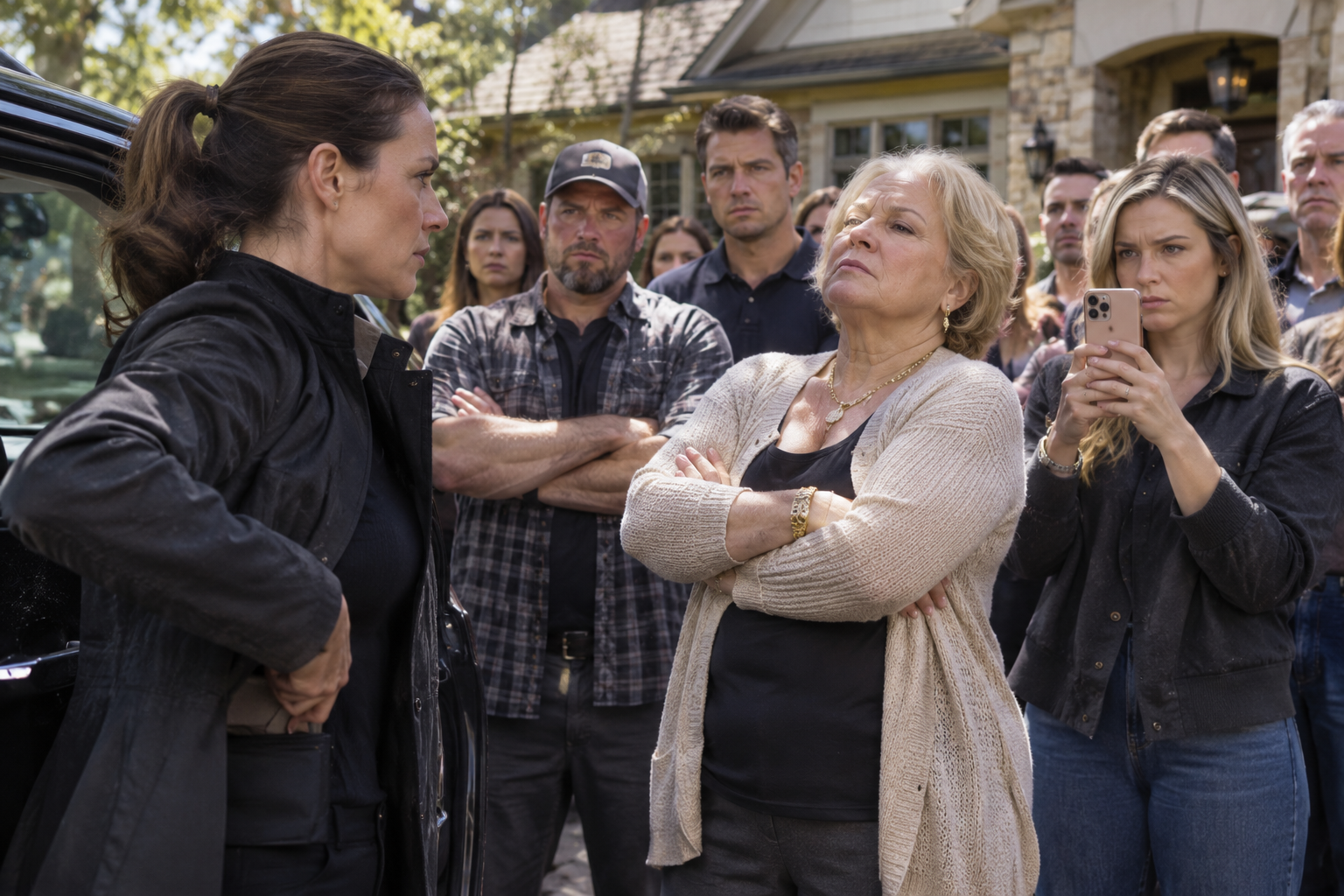
At Grant’s driveway, cars filled the space beside the house. Grant stood near the garage with Patricia, Vanessa, and several other relatives. Owen was at the front door, his hand on the knob.
Patricia hooked her purse over her wrist and stepped toward my car. “You need to leave. Grant has this handled.”
“Where is Sophie?” I asked.
Vanessa raised her phone, holding it upright against her palm. “Why did you call the police?”
“She needs an ambulance. Where is she?”
Grant moved a pair of shoes off the front step and set them neatly against the wall. “You’re overreacting, Mara. We can take care of her.”
The door opened behind him. Owen came out with Sophie beside him, his hand on her back. She had one shoe fastened and the other strap hanging loose.
I went to her. “Can I pick you up?”
She nodded, and I lifted her against my navy coat. She tucked her face near my shoulder and took hold of the coat. Her loose shoe knocked against my knee.
“Put her down,” Grant said. “She’s staying here.”
“No.” I kept my phone on speaker. “The ambulance is coming.”
Patricia reached for my car door. I stepped back with Sophie and spoke toward the phone. “We’re at Grant’s house. The address is the one I gave you.”
“I have it,” the dispatcher said. “Are you and Sophie together?”
“Yes. I’m holding her.”
“Stay back,” I told them. “The dispatcher can hear us.”
Vanessa lowered her phone a little. “Are you taking her to the hospital?”
“Yes,” I said. “She needs to be seen.”
Sophie looked down at her shoe. “It’s open.”
“I see it.” I bent as far as I could and pressed the strap closed with one hand. “There. Now it matches.”
She looked at the other shoe and gave a small nod. At the end of the street, a police car turned toward us, followed by an ambulance.
An officer came up the driveway. “Is this Sophie?”
“Yes,” I said. “I’m her mother.”
A paramedic brought a stretcher close and asked if Sophie could sit on it. She held on to my coat, so he folded a blanket over the seat and told me I could stay beside her. The officer asked Grant to move away from the ambulance doors.
While the paramedic checked the straps, I sent my supervisor a message: “I need unpaid leave starting today. Sophie is going to the hospital.” My supervisor wrote back, “Take the time you need.”
“Can I ride with her?” I asked.
“Yes. Climb in beside her.”
Sophie kept hold of the navy coat as we went into the ambulance.
A paramedic asked me to move back so she could check on Sophie. I shifted along the bench and told Sophie I was staying with her.
By eleven the next morning, a tray of breakfast sat untouched beside her hospital bed. Denise pulled a chair close to mine while Sophie rested.
“The doctor wants to keep watching her today,” Denise said. “We’ll make sure you have the instructions for her care before she goes home.”
“Can I take her home when she’s ready?”
“We’ll talk to the doctor about when. First, call your attorney about an emergency custody order.”
I had the attorney’s number on the back of the dentist’s appointment card. I held it while Denise moved the breakfast tray out of Sophie’s reach.
Sophie opened her eyes. “Is that egg?”
“It is,” I said. “I can ask for something else.”
“Toast without the egg?”
Denise found the call button, and I asked for toast. Sophie shut her eyes again, with one hand resting on the blanket.
An officer came to the door and asked whether I could step into the hall. He had spoken with people at Grant’s house, but he still needed to collect their accounts.
“Why did Owen call me?” I asked. “Why didn’t he call for an ambulance?”
“The relatives argued about taking her for help,” he said. “Owen called you after that argument, not before she was hurt.”
My phone lit up while he spoke. Grant had sent another message.
I opened it. “Delete the video,” it said. The one before it warned me that the video could cost him his job.
“Can I give you these?” I asked the officer.
“Yes. Send them to the address on this card, and keep the originals.”
I sent both messages while he waited. I did not tell Grant where they had gone.
Back at Sophie’s bedside, I called my attorney. Denise moved her chair nearer so she could hear without waking Sophie.
“Please seek an emergency order,” I said. “I don’t want her sent back there.”
“I’ll file the request,” the attorney said. “Keep the messages and the video. The hearing is set for August 24, and we’ll need the records in order.”
I wrote the date on a fresh sheet, then listed the dentist’s finding, Grant’s text about Owen, the video, the hospital records, and his demands to delete it. I left space beside each item for its date, as Denise had shown me.
“Will the dentist’s note help?” I asked.
“It can show when you sought care,” my attorney said. “On its own, it doesn’t establish what caused the soreness.”
I told my supervisor I would need more unpaid leave. Then I picked up my pen again.
“I want to ask Sophie what happened,” I said.
“A trained interviewer can speak with her,” Denise said. “Don’t make her tell it twice.”
I wrote that down and drew a line beneath it.
Denise moved the breakfast tray away from Sophie and set a napkin over the plate.
“Will the court want all of it?” I asked.
“Let your attorney decide what to offer,” she said. “Keep the originals.”
I put the appointment card and my notes back in my bag. The officer had the messages from Grant, and I had copies for my attorney. I wrote August 24 at the top of a fresh page.
On August 24 at 10:30, my attorney opened a folder at the counsel table. Grant sat across from us, moving a water glass until it stood square with the edge of his papers. The temporary order had stopped visits, but today the judge would decide what came next.
“Do you still want to offer the records in date order?” my attorney asked.
“Yes,” I said. “Start with the dentist.”
She handed me a copy of the printed finding. I had paid her bill the week before, and the receipt was still tucked behind the page. She slid it out and passed it back to me.
The judge took the finding and read it. My attorney asked me what had brought Sophie to the appointment, and I told her about the pancake and Sophie’s sore mouth.
“Did the dentist find a tooth that needed treatment?” she asked.
“No,” I said.
Grant leaned toward his attorney, who put a hand on the table. The judge admitted the finding, then my attorney picked up the next page.
“Is this Grant’s response to your question about Owen?”
“Yes. He sent it on the day of the exchange.”
My attorney read the words aloud. “I was always there.”
Grant reached for his water, then set it back without drinking. My attorney offered the video and the hospital records next. She asked for the video to be played, and the judge agreed.
I kept my eyes on the table while Sophie’s voice came through the speaker. Grant’s laugh followed it. My attorney stopped the clip and handed up the hospital records.
Grant’s attorney asked whether the dental finding identified what had caused the soreness. I said it did not. Then my attorney offered Grant’s later messages asking me to delete the video.
“Did you delete it?” she asked.
“No. I gave the messages to the officer.”
The judge accepted them. My attorney closed her folder, and Grant straightened his stack of papers again. One corner of the top page kept curling up.
When the judge returned, she awarded me sole custody. Grant would have no contact with Sophie unless a court later approved it after review.
“Do you understand the order?” she asked him.
“Yes,” he said.
Outside the hearing room, my attorney held the door while I put the receipt into my bag. My phone lit up before I could close it. Vanessa had sent a message.
“Can you send me whatever recording the lawyers have?”
I showed the screen to my attorney. “Do I have to answer?”
“No,” she said. “Let me find out what else is available first.”
I put the phone away. “Would there be more than the clip Grant sent me?”
“There could be. I’ll ask.”
By winter, I had sat through two plea hearings. Owen admitted felony child abuse and received prison time. Grant admitted an endangerment charge. Afterward, I asked my attorney for the case material available to her.
At two on a winter afternoon, Denise sat beside me in my attorney’s office. My attorney placed a closed folder on the desk and turned her computer toward us.
“This recording was recovered from Grant’s phone,” she said. “It’s longer than the clip he sent you.”
“How much longer?” I asked.
“Long enough that I wanted you to have someone here.” She rested her hand beside the keyboard. “We can stop whenever you ask.”
Denise moved a box of tissues within reach, then took one for herself. “This office keeps the heat high,” she said, wiping her nose.
My attorney pressed play. I recognized the beginning at once, Sophie on the couch, Grant behind the phone. I had watched that part before, and my hand went to the edge of the desk.
When the clip I had received ended, the recording kept going. There was a scrape, and then Grant spoke.
“Ask for your mother again,” he said.
Sophie made a small sound I could not make out. I leaned toward the computer.
Then my own voice came through the speaker. I heard myself tell Sophie that I could not come that Thursday, that I loved her, and that I would see her soon.
“Stop it,” I said.
My attorney pressed a key. The room went quiet, and I kept my hand on the desk.
“He saved my message,” I said. “He played it to her.”
Denise nodded. “He did.”
I thought of Sophie at my kitchen table, asking whether a phone could hear her when nobody had called. My answer that morning had been no. I had not known she had heard me from a phone when I was somewhere else.
“Did she answer him after that?” I asked.
“We can listen,” my attorney said. “You don’t have to do it today.”
I shook my head. There was a folded drawing in my bag that Sophie had asked me to put on the refrigerator. She had drawn our bedroom door open, with a crooked yellow knob.
My phone lit up when I took it out. Vanessa’s request was still on the screen. I opened it, then held the phone above the desk.
“Keep the recording with the file,” I said. “She doesn’t need to hear it again. Neither does Sophie.”
My attorney closed the folder. I turned my phone face down beside it.
Denise reached for her purse, then stopped. “Do you want me to stay a few more minutes?”
“No. Thank you for coming.”
My attorney slid the folder into a cabinet behind her desk. She locked it and put the key in a small dish.
That evening, Sophie and I sat beside the mattress on my bedroom floor with a basket of clean laundry between us. The clock showed 7:30, and she was trying to fold a towel that was wider than her arms.
“Can you hold that end?” she asked.
I took the two corners nearest me. We brought our hands together, but one edge hung well below the other.
“It looks like a tent,” Sophie said.
“A crooked one.”
She pulled the towel apart and we tried again. This time she laid it on the stack without asking me to fix it.
I stood and went to the bedroom door. “Do you want it open or nearly closed tonight?”
“Open, please.”
I pushed it back against the wall. Light from the hall reached the edge of the mattress, and Sophie went on sorting the laundry.
My navy coat was draped over the chair by the closet. I put it on a hanger, leaving one pocket turned out from the last wash.
“Your coat has an ear,” Sophie said.
“It does. Should I put it back in?”
She looked at the white lining. “Leave it. Then you can hear me from the closet.”
I left the pocket as it was and hung the coat up. When I came back, Sophie had found one striped sock at the bottom of the basket.
“The other one was here,” she said. She lifted a T-shirt and shook it over her lap.
A washcloth fell out. Then a pair of underpants landed on her foot.
“Not that,” she said, and tossed them onto the bed.
I picked up the washcloth. “Should I look under the towels?”
“I’ll look.” She reached beneath the last folded towel and brought out the mate.
She held the socks side by side, checking that the stripes matched. Then she tucked one inside the other and rolled them into a ball.
“Which cartoon?” I asked.
“The one with the dog who can’t find his hat.”
I found it on the television, and she asked me to turn the sound down one notch. We settled on the mattress with the laundry basket at our feet. Sophie set the paired socks beside me and pulled the blanket over her legs.
I put the socks in the drawer she could reach.