Ellen lifted Daniel’s breakfast plate from the cupboard, then put it back. Henry stood at her kitchen table with an unopened envelope in his hand.
“It’s eight ten,” she said. “Did they give you a time?”
“They gave me an appointment.” Henry slipped a finger under the flap. “The transport office sent it yesterday.”
Ellen carried her own plate to the sink. She had made toast but left half of it on the plate. “Is that the time he’ll get here?”
“It’s the time we’re expected to receive him. The trip itself isn’t guaranteed yet.”
Henry was the funeral director in Alder. He had come before opening the funeral home, still wearing his good coat. He drew a sheet of paper from the envelope and checked the top line.
“Tomorrow at noon,” he said. “It’s written right here.”
Ellen came around the table to read it. Daniel’s name was on the page, followed by the funeral home’s address. She pressed the paper flat against the table edge.
“Will they call if they’re delayed?”
“Yes. I’ll call you as soon as I hear from them.” Henry took a pen from his coat pocket. “May I put it on your calendar?”
She pointed to tomorrow’s square. He wrote NOON in the space beneath a church supper circled in red.
“The forecast on the radio said snow before dawn,” Ellen said. “How much?”
“They’re still deciding. The highway is the usual route, but I’ll check the reports.”
He set the pen down. Earlier, he had described how he would receive Daniel at the funeral home and bring Ellen inside when she was ready. She had nodded then. Now she looked at the empty chair across the table.
“Would anybody be there when he comes in?” she asked.
“I’ll be there. And you, if you want to be.”
Ellen picked up the plate again and scraped the toast into the trash. Daniel had always eaten the crust first, claiming the middle was worth saving. Once he had tried to convince her it was a Marine rule.
She rinsed the plate and turned off the water. “I’ve seen riders at services. Could they meet him on the road?”
Henry rested his hand on the back of the chair. “I know people I can call. I can’t say yet whether they’ll be able to ride.”
“Because of the snow?”
“Because of the roads, and the timing. They would need a place to meet the vehicle, too.”
She had never met those riders. Asking meant giving up the quiet arrival Henry had offered, and asking people to make room in their day for her son.
“Please ask them if they can meet him.”
“I will,” Henry said.
He placed the envelope beside the telephone and began dialing.
Ellen took a pencil from the drawer and laid it beside the telephone. She waited while Henry spoke, then wrote down the number he gave her.
“I’ll call again when I know more,” he said after he hung up.
“Will they have enough time to find riders?”
“I’ve asked someone to look into it. I’ll come back before lunch.”
At 10:20, Henry returned carrying a county road map. Ellen had the church supper invitation in her hand and a box open on the table.
“I thought I’d put this away,” she said. “They sent it early enough that I almost forgot where I put it.”
Henry set the map down beside the box. “May I borrow this end of the table?”
She moved the box, and he spread the paper open. A blue line followed a secondary road toward Alder. It stopped near town, short of the highway he had described that morning.
“Is that where Daniel will come in?”
“The highway is the ordinary route,” Henry said. “That’s still the route we’re expecting.”
Ellen put her finger on the blue line. “Who drew that blue line?”
“Someone checking the roads for us. I brought it so we’d have the same map in front of us.”
He reached into his coat for a folded weather report. Ellen kept her finger where it was.
“You said snow was coming. Has that changed?”
“The forecast calls for the worst of it before dawn tomorrow,” he said. “The highway could be difficult after that, especially where it’s exposed.”
“Is it open now?”
Henry checked the time on the report, then took out his phone. Ellen waited while he called for the current road conditions.
“Yes,” he said after he hung up. “The highway is open for now.”
“For now,” she repeated. “And this other road?”
“It’s open too. We can keep checking both.”
Ellen looked from the blue mark to Henry. Somebody had already taken a pen to the map while she had been waiting for a call about riders.
“Could they meet him if the route changes?”
“I don’t know yet. They’ll need to see where the vehicle can safely stop.” Henry put the report beside the map. “I’ll make sure they have the latest information.”
Ellen slipped the invitation into the box. The reservation was still held to the refrigerator by a magnet shaped like a pear. She took it down and tore it in half.
“I was supposed to bring a pie,” she said.
Henry held out the box. “Would they miss the pie?”
“They might. It was going to be store bought.”
She dropped the reservation into the wastebasket. Henry gathered the report and folded the map with the blue road showing.
“Would they need to hear from me?” Ellen asked.
“Not yet,” Henry said. “I’ll take the map over and give them your number.”
At 1:15, Grace held down one corner of the map on the garage workbench while Frank weighted the other with a wrench. The radio beside them crackled through a road report.
“Henry said noon tomorrow?” Grace asked.
“Yes. He asked if we could put an escort together.”
Grace traced the highway with her finger. “And the blue road?”
“Another road we can check,” Frank said. “First we need a place to meet the vehicle.”
She looked at the lot he pointed to just outside town. “Will they have room to pull in?”
“Enough room. The building gives some shelter from the wind.” Frank reached under the bench and brought out a wooden stake. “We can mark the entrance.”
A roll of orange ribbon sat in a drawer with spare fuses. Grace cut a length and held it while Frank tied it around the stake.
“Will anyone see that from the road?” she asked.
“If they’re looking for it. I’ll put it at the lot before we meet.”
Grace set the scissors down. “We’ll need riders who can leave tomorrow morning, and we’ll need them ready for a change.”
Frank crossed to the nearest motorcycle and pressed a gauge onto a tire valve. “We’ll need them to accept the conditions first.”
Grace switched on the lights while he checked the tires. The rear light stayed dark until she pressed the brake.
“At least one of us remembered how,” she said.
Frank looked up. “I was giving you a chance.”
She turned off the engine and picked up her phone. “I can start calling. Will you handle the route?”
“Yes. But every rider hears this from us: if the road closes, we stop. Nobody votes on that.”
“And if it’s open but too rough?”
“We check it before anyone sets out. Open doesn’t always mean safe for a motorcycle.”
Grace put the phone down without dialing. “Some of them will have to arrange time off.”
“I know. Tell them before they say yes.”
The radio gave the forecast again. Frank leaned closer to catch the county names, then wrote a number for the road report on the edge of the map.
Grace opened her phone contacts. “How many should I ask?”
“Start with the people you can reach. We’ll see who can be ready.”
She called the first number. When nobody answered, she left a message asking for a return call, then tried another. That call went unanswered too.
“Do you want me on the list?” Frank asked.
“Yes. Me too, if we’re counting.”
Grace pulled a clean sheet from beneath a parts catalog and wrote Frank’s name at the top. She added her own beneath it.
“Henry wants to see you at three thirty,” Grace said. “Ellen will be there.”
Frank glanced at the phone on the workbench. “I can make that.”
At the funeral home, Ellen set a battered thermos on the arrangement room table. Henry moved a box of tissues aside and spread the county map where all three could see it.
“I brought coffee,” she said. “I did not know if you had eaten.”
“I have,” Frank said. “Coffee would be welcome.”
Ellen poured some into a paper cup. The thermos had a dent near its base, and she held it upright a second longer to stop the last drop from falling on the map.
Henry pointed to the sheltered lot outside town. “This is the pickup we discussed.”
“Will the riders be there?” Ellen asked. “I need to know they will meet him.”
Frank looked at the blue line on the map before he answered. “I cannot promise that yet.”
“The lot is sheltered,” she said. “You chose it.”
“Yes. But the approach to it is exposed. If the wind puts snow across that stretch, shelter at the lot will not help the riders get there.”
Ellen put the thermos down. “What about this road?” She touched the blue mark Henry had brought to her kitchen.
“I marked it,” Frank said. “It may take us around the exposed part of the highway. We still have to see what the storm does to it.”
Henry held one corner of the map flat. “The report I checked at three said both roads were open.”
“For now,” Frank said. “I can promise to check the road. I cannot promise the road will stay open.”
Ellen looked from him to Henry. “I am asking you to meet my son. I thought that was what we were arranging.”
“We are trying,” Frank said. “Grace is calling riders this afternoon. None of us can make the forecast settle sooner.”
Ellen took her hand off the map. She had asked in front of both men, and neither had a promise to give her. “All right. I will stop asking for the lot.”
Frank pushed the paper cup closer to the thermos. “Let me see what I can arrange here for you, too.”
A telephone rang at the desk in the hall. Henry stepped to the door, then called back, “Ellen, it is for you.”
She went out, pulling the door nearly closed behind her. Frank waited until her voice reached them from the hall.
“If the roads are unsafe,” he said to Henry, “the direct arrival is still our fallback.”
“Straight here, without the riders,” Henry said. “I can receive Daniel.”
“I will check again tonight,” Frank said. Henry folded the map as Ellen returned and found it between them.
Ellen put her hand on the back of a chair. “Grace is still calling people?”
“She is,” Frank said. “I can give you her number if you want to ask her yourself.”
“I would rather see her.”
At five, Ellen found Grace at the garage workbench with a phone in one hand and a list under the other. The radio crackled behind her, and a pair of motorcycle boots stood beneath the bench.
“Have you heard from everyone?” Ellen asked.
“Nearly everyone. One man said he would call after work.” Grace turned the phone so Ellen could see the screen. “He has not answered my last message yet.”
Ellen took Daniel’s note from her coat pocket. She had read it again at home before coming to the garage. It said, “Mom, there is coffee in the cupboard. Love, Daniel.”
She folded it along the old crease. Grace pulled a stool out from under the bench, and Ellen sat down with the paper in her hand.
“He always told me when he bought coffee,” Ellen said. “Usually because he had finished the last of mine.”
“Did he buy the kind you liked?”
“No. He liked his strong enough to stand a spoon in.” Ellen tucked the note into her pocket. “I drank it anyway.”
Grace’s phone lit up. She read the message, then picked up the list and counted the names with her finger. She went back to the top and counted once more.
“Six,” she said. “That includes Frank and me.”
“Are they all coming to the pickup?”
“They are ready to try. Every one of them knows we may have to stop if the road is unsafe.” Grace put the list beside Ellen. “Frank will check it again before anyone leaves.”
Ellen looked at the six names. There was room at the bottom of the page for another, and she set her finger there.
“Would another rider make it easier?” she asked.
“No. Not on a bad road.” Grace took the list back and slipped it beneath the phone. “Six can still be too many if the conditions turn.”
Ellen drew her coat close. “I wanted them with him from the pickup all the way home. If you get there and it is safe, you can do that?”
“Yes. But if it changes, we may have to leave the pickup or stop before we reach it.”
Ellen pressed her palm over the pocket where the note rested. “Then you leave if you need to. I do not want anyone hurt trying to keep a promise to me.”
Grace nodded and reached for her phone. “I will tell the others that is settled. Frank said he would speak with you again tonight about tomorrow.”
Ellen’s finger found the edge of the folded note. She left it in her pocket and let Grace make the calls.
Grace held the phone against her shoulder and checked the garage radio. Ellen waited until she had the forecast station.
“Will you tell me if the pickup changes?” Ellen asked.
“Yes. Frank will check again tonight, too.”
At 7:10, Ellen pushed open the funeral home door. Frank was carrying a chair into the arrangement room, and Henry held another by its back.
“Are those for tomorrow?” she asked.
“They are,” Henry said. “We can move them wherever you want.”
Frank set his chair near the heater and plugged it in. “This room will be warm before you get here. You will have a place to wait, whatever the road decides.”
Ellen took off one glove. The heat was already coming through the grille.
“Will Henry call me before Daniel leaves the pickup?” she asked.
“He will,” Frank said. “If the riders can meet him there.”
Henry put his chair beside the empty receiving table. He stepped back, then moved it a few inches closer.
Ellen watched him. “Who is that one for?”
“For anyone who needs to sit near him,” Henry said. “You, if you like.”
A knock sounded at the door. Ruth came in holding a small paper flag on a thin wooden stick. One corner had been folded over and pressed flat.
“I made it for the gathering,” she said. “I nearly glued it to my kitchen table.”
Ellen took the stick carefully. “Did you get it loose?”
“Yes. The table kept a piece of the newspaper underneath.”
Ellen looked at the little flag. Ruth had colored its stripes by hand, and one blue corner showed the marks of a pencil. “Thank you,” she said.
Ruth unknotted the cord on her coat. “Would you like me here with you tomorrow?”
“Yes. If you can come early.”
“I can. I’ll bring a cup for your coffee.”
Frank rested his hand on the back of a chair. “Henry can receive Daniel privately if the roads demand it. You and Ruth can wait here, and he will come for you.”
Ellen looked toward the receiving table. There was room for Henry to bring Daniel in without anyone else seeing.
“Have you decided that’s what we’ll do?” she asked.
“No,” Henry said. “The road will tell us what we can do. I wanted the room ready.”
She turned the flagstick between her fingers. “And the ribbon at the pickup? Will someone take it down if the riders can’t go?”
“We’ll see to it,” Frank said. “For now it’s still there.”
Ellen put her glove back on. “I’ll wait here tomorrow, then. I won’t go out to the pickup.”
Frank pulled the chair by the heater a little closer for her. Ellen carried the flag to the table and set it beside the extra chair.
“Will you call if the report changes?” Ellen asked.
“Tonight,” Frank said. “You should not have to wait until morning to hear from us.”
At nine, Grace stood at the garage workbench while Henry held down one corner of the county road map. Frank had brought in the latest road report.
“What does it say about the pickup?” Grace asked.
Frank laid the report beside her list. “The approach is exposed for four miles. Drifting snow and wind. It is still open, but I would not send motorcycles out there.”
“Not even if we leave early?”
“No. We cannot use that pickup.”
Grace took the list from under the report and crossed out the time she had written beside the sheltered lot. The six names remained. “I will have to call them.”
“Let me call,” Frank said. “I told them I would make the road decision.”
Henry ran a finger along the blue line on the map. “This road near town is open on the report. The funeral vehicle can use it if the highway gets worse.”
Grace leaned over the bench. “Why was that marked before I started calling riders?”
Frank looked at Henry, then moved the report so Grace could see the whole map. “We wanted another way in if the highway became difficult.”
“I know that part. Was it meant for us?”
“It could have been,” Frank said.
The radio crackled behind them. Henry turned the volume down before the announcer finished giving the temperature.
Grace set her pencil beside the map. “Frank, was there another plan for Daniel?”
“Yes,” he said. “Henry and I talked about bringing him straight to the funeral home without riders if the roads were unsafe.”
Grace looked at the crossed-out time. “After I called the others?”
Frank shook his head. “We talked about a direct arrival before I called you.”
Henry straightened the edge of the report. “We still wanted to see whether the escort could be done safely.”
“And the room for Ellen?” Grace asked.
“It was there if she needed to wait,” Frank said. “And if Henry had to receive Daniel privately.”
Grace picked up the list again. “She has not been told when you made that plan.”
“No,” Henry said. “We should tell her.”
For a moment Grace held the paper over the wastebasket. Then she put it back on the bench. Four other riders had checked their lights, made room in their schedules, and agreed to be ready. She could not give them those hours back.
Henry reached for the garage telephone. “I will call the transport driver. I want to know where he can stop safely if the route changes.”
Frank took Grace’s list. “I will let the riders know the long approach is off. They can stay home until we have checked the morning report.”
“Do not throw that list away,” Grace said.
“I would not dare.” Frank went into the office with it.
Grace pulled the map closer. The blue road entered Alder not far from the funeral home. She picked up her pencil and drew a smaller circle around it.
Frank’s phone rang, and he stepped into the office to answer it. Grace kept her pencil on the paper until the door closed.
“Does Ellen know you talked about bringing him straight in?” she asked Henry.
“No,” Henry said. He looked toward the office. “Frank said he would tell her.”
At 6:45 the next morning, Ellen found Frank outside the funeral home with a strip of orange cloth in his hand. Henry stood by the entrance, holding a salt bucket.
“Is that from the pickup?” Ellen asked.
Frank held it out. “I took it off the stake. We can’t use that approach.”
She took the ribbon but kept her hand open. One end had a small knot in it, pulled tight enough that she could not see where to begin loosening it.
“Has Daniel started?” she asked.
“Henry checked with the transport,” Frank said. “He’s on his way.”
Ellen looked toward the street. A plow had passed, leaving a ridge along the curb. She had pictured the riders waiting for him outside town, with hours still ahead of them.
“Are the riders dismissed?”
“From the long route, yes. I told them not to set out while we checked for an alternative.”
“So they might still ride?”
“If we find a route I can approve. I haven’t sent them home for good.”
Henry set down the bucket and scattered salt across the entrance walk. Ellen stepped toward him, but Frank put out a hand.
“Wait there a second,” he said.
He took the bucket from Henry and covered the patch where Ellen was about to put her foot. Henry opened the door and wedged a folded piece of cardboard under it.
“That was my best doorstop yesterday,” Henry said. “Today it seems to have other ideas.”
Ellen held the door while he bent to fit the cardboard farther underneath. When he straightened, she asked him where the vehicle would go if no riders met it.
“Directly here,” Henry said. “We’ll be ready to receive him.”
Frank set down the bucket. “Henry and I discussed that before I called Grace.”
“Before she started finding riders?” Ellen asked.
“Yes. We wanted a safe way to get him here if the roads got bad.”
Ellen turned the ribbon over in her hand. “Why didn’t you tell me then?”
“I should have told you when we spoke about the room,” Frank said. “I knew you wanted the pickup, and I couldn’t promise it.”
She pressed the knot between her thumb and finger. “He’ll travel those miles without them.”
“I would rather disappoint you than send them where I cannot keep track of them,” Frank said.
The door shifted against the cardboard, and Henry caught it before it closed. Ellen thanked him and stepped inside.
“Will you let me know if there’s another way?” she asked Frank.
“I will.”
Ellen put the ribbon in her coat pocket beside Daniel’s note.
At 8:30, Ellen sat in Grace’s parked car with the county map across their knees. Two riders waited near the funeral home entrance, stamping their boots on the pavement.
Grace held up the battered thermos. “Is this still yours?”
“It was Daniel’s first. The lid leaks if you tip it too far.”
Grace opened her door and poured coffee into two paper cups. One rider took both cups while the other tucked his gloves under his arm.
“Tell them not to leave yet,” Ellen said.
Grace passed along the message and settled back into the driver’s seat. She unfolded the map farther, exposing the blue line near town and a smaller circle she had drawn beside it.
“What is that circle?” Ellen asked.
“A place we might meet the funeral vehicle. I haven’t checked it this morning.” Grace pressed her phone against the steering wheel. “The report could have changed.”
Ellen held the map down while Grace called for the road report. A recorded voice listed several county roads, and Grace reached for a pencil when it named the one marked in blue.
“That road is open,” she said when the call ended. “The report doesn’t tell us how the meeting place looks.”
“Could Frank check it?”
“Yes. He’ll want to check the whole stretch before he sends anyone out.”
Ellen looked past the riders to the road. A plow had left a ridge at the edge of the parking lot, with a narrow opening where cars could enter.
“What if they met Daniel there, near town, and rode with him from that point?” she asked. “Then they could stand in a line when he arrived here.”
Grace laid the pencil across the map. “We could ask. Henry would have to find a safe place for the funeral vehicle to meet us.”
Ellen reached into her pocket and touched the folded note. She left it there. The ribbon was beneath it, no longer needed at the distant pickup.
“We cannot give him those miles back,” she said. “Let us give him the miles we can.”
Grace looked at the circle. “Frank hasn’t seen this. He may still say no.”
“Then please ask the riders to be ready to discuss it. Nobody should set out unless Frank agrees.”
Grace lowered her window and called the two riders over. She showed them the marked road and told them the plan still needed Frank’s approval. One handed back an empty cup and asked if there was enough coffee for another.
“There is if you share,” Grace said. She poured the last of it between the cups, then closed the thermos.
Ellen took the pencil. “We’ll need Henry too. He knows where the vehicle can pull over.”
Grace shifted the map so Ellen could reach the road. Ellen circled the nearer meeting point and handed it to her.
“Will you bring it inside?” Ellen asked. “I want Frank to see it before anybody starts a motorcycle.”
Grace put the map on the seat between them. “Yes. I’ll get the report, too. Frank will want the latest one.”
At 9:15, Henry brought the arrival envelope to the arrangement room. Ellen stood at the table with Grace and Frank while the other riders waited outside. She took the paper from the envelope and found the appointment.
“Daniel is due here at noon,” she read. “We have enough time to do the shorter route carefully.”
Frank looked at the map Grace had spread out. “How much shorter?”
“From this road into town,” Ellen said. “Then the riders could stand at the entrance when he gets here.”
Grace laid the road report beside the map. “The road is open. The report came in a few minutes ago.”
Frank followed the marked road with his finger, stopping at the circle. “Where can the funeral vehicle meet us?”
Henry leaned over the table. “There’s a wide entrance to the county lot there. The driver can pull in without blocking the road.”
“Can the motorcycles wait off the road, too?” Frank asked.
“Yes. I’ll call the driver and make sure the entrance has been cleared.” Henry reached for the telephone. “And I’ll ask for a call before he gets there.”
Frank checked the report again. “Four miles from that lot to here. We can ride that if it stays open. No one leaves before I’ve checked it once more.”
Ellen kept her hand on the appointment paper. “Will you do it?”
“Yes,” Frank said. “We’ll meet him there, provided the road stays safe.”
Grace let out a breath and moved the report so Frank could take it. Outside, one of the riders stamped a boot on the pavement. Another lifted a cup to the window, asking without words whether anyone inside wanted coffee.
Henry shook his head. “I’ve had enough to keep me awake through supper.”
“I haven’t,” Grace said, and raised two fingers. The rider nodded and went back to the car.
Ellen looked at the place on the map where the longer escort would have begun. She put the appointment back in its envelope and left the map open to the nearer road.
“Frank, will you tell them yourself?” she asked. “I don’t want anybody hearing half the plan.”
“I will.” He picked up the report. “Henry, call me as soon as you hear from the driver.”
Henry lifted the receiver. Grace held the door while Frank went out to the waiting riders.
“County lot,” Frank told them. “That’s where we’ll meet the funeral vehicle.”
Grace checked the list once more, then tucked it into her coat. The riders began pulling on their gloves.
“Will you call when you reach the lot?” Ellen asked.
“I will,” Frank said. “We’ll wait there until Henry’s driver comes.”
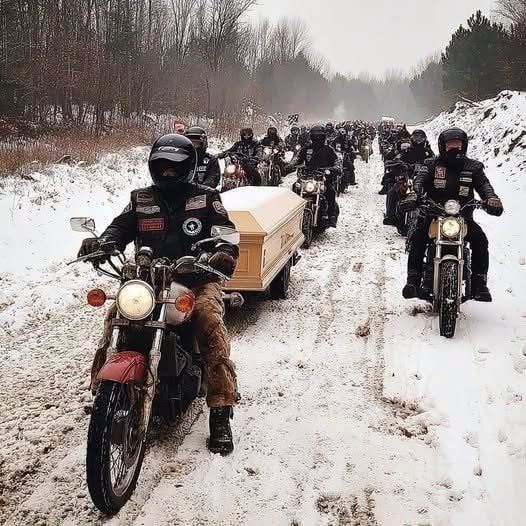
At 11:40, Ellen stood with Ruth at the funeral home entrance. A few neighbors had gathered along the street, their flags held close against their coats.
“I asked them to come,” Ruth said. She held the cord of her coat in one hand. “I should have asked you first.”
Ellen looked down the street. One neighbor had brought a folding chair, though no one was sitting in it.
“Could they stand back from the entrance?” she asked.
“I’ll see to it.” Ruth went down the steps, and the neighbors moved a little farther apart.
Henry opened the door behind Ellen. “The driver called at 11:35. They were near the edge of town.”
“Were the riders with him?”
“Yes. All six.”
Ellen took the orange ribbon from her pocket. She had meant to put it somewhere before the vehicle arrived, but she still held it when she heard the engines.
The funeral vehicle turned onto the street. The motorcycles followed at a cautious pace, with Frank in front of the other riders. Ellen gripped the ribbon as they came toward her.
Ruth returned to her side. “Would you like me to stay here?”
“Please.”
The vehicle stopped at the entrance. Frank and Grace parked with the other riders, then came toward the walk. Ellen folded the ribbon and slipped it back into her pocket.
Henry stepped close enough that she could hear him. “Frank was checking on each rider through the night. He called me after his last round.”
Ellen watched Frank speak to Grace. She pointed toward the entrance, and the riders began taking their places on either side of the walk.
“He bought the hand warmers too,” Henry said. “Twelve dollars for the package. He wanted everyone to have a pair.”
Ellen put her hand in her pocket again and found Daniel’s folded note. “Can I put this beside him?”
“Yes,” Henry said. “I’ll take you in.”
Frank came up the walk before they went inside. There were neighbors close enough to hear Ellen if she spoke about the pickup they had lost. She looked at him and said, “Thank you for bringing him this far.”
Frank nodded. “We were glad to be there.”
Inside, Henry waited while Ellen placed the note beside Daniel. She pressed the fold once with her fingertip, then let it rest. Ruth stayed beside the doorway until Ellen turned back.
Outside, Frank stepped into line with Grace and the others. The riders held their helmets against their coats.
Ellen stood beside Ruth until Henry came to the door. He held it open, and Ellen went inside with the orange ribbon still in her pocket.
At eight the next morning, Ruth lifted a plate from Ellen’s kitchen table. The ribbon lay beside it, where Ellen had taken it from her coat.
“May I put this in the sink?” Ruth asked.
“Please. I’ll wash it later.” Ellen picked up the ribbon and held one end between her fingers. “I don’t know where to put this yet.”
Ruth set the plate down by the faucet. “Would you like me to find a box?”
Ellen shook her head. She pulled open the kitchen drawer where she kept pencils, rubber bands, and a small pair of scissors. The drawer stuck halfway, and she gave it another pull.
“The riders got home all right,” Ruth said. “Grace called me last night.”
“All six?”
“All six. She said Frank made sure.”
Ellen laid the ribbon in the drawer, beside the scissors. She left it loose, with the ends resting over a packet of rubber bands, and pushed the drawer shut.
Ruth picked up the paper flag from the table. Its stem had bent a little, and she eased it straight with her thumb.
“Do you want this put away too?” she asked.
Ellen looked toward the drawer. Then she moved a folded dish towel from the table and set it on the counter. “No. There is room for it right here.”
Ruth took a glass jar from the shelf and set it beside the calendar. She lowered the flag into it, but the stem leaned over the rim.
“It won’t stay up,” she said.
“Try turning it around.”
Ruth did, and the flag leaned the other way. Ellen reached into the drawer and took out a rubber band. She wound it around the lower end of the stem, and Ruth tried the jar again.
This time the flag stood upright. Ruth let go of it carefully, then drew her hand back.
“I could use a cup of tea,” she said.
“So could I.” Ellen filled the kettle and put it on the stove. She took two cups from the cupboard, checked that both were clean, and carried them to the table.
Ruth pulled out a chair, but waited until Ellen sat down. From her place, Ellen could see the flag beside the calendar. She moved one cup closer to Ruth and left the other where it was.
The little flag stood between the cups.