The kitchen is quiet now. The lights are off. The dishes are stacked. The house is settling into the deep stillness of night. You lock the door, brush your teeth, and slide into bed believing your home is safe.
But in many households, danger doesn’t announce itself with smoke alarms or sparks. It waits silently, inches from the wall, humming softly through a cord most people never think twice about.
A single plugged-in appliance.
Every year, thousands of house fires begin this way — not with dramatic explosions or reckless behavior, but with routine, everyday habits. According to fire safety experts, one of the most overlooked risks happens after dinner, after cleanup, after everyone believes the danger has passed.
It happens when we go to sleep.
A Fire That Starts Small — And Grows Fast
Electrical fires rarely begin with roaring flames. They start subtly. A wire warms. Insulation weakens. A connection loosens. Heat builds slowly, invisibly, until the conditions are just right.
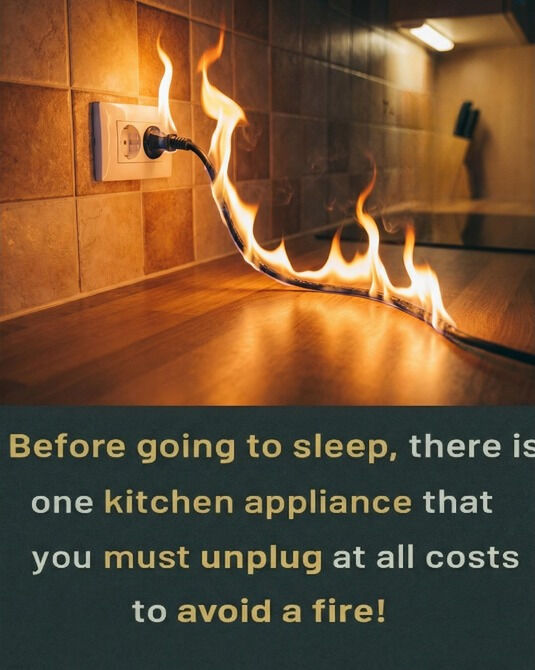
In the image above, flames crawl along a power cord plugged into a kitchen outlet. It’s a striking visual, but it reflects a very real and increasingly common scenario. Countertops, backsplash tiles, wooden cabinets, and plastic cords create a perfect environment for a fire to spread once ignition occurs.
Unlike stovetop fires, which often happen while someone is present, electrical fires frequently ignite when no one is watching — late at night, while families sleep.
By the time smoke alarms activate, escape windows may already be narrowing.
Why the Kitchen Is the Most Dangerous Room at Night
The kitchen is designed for activity, not rest. It contains more electrical devices than almost any other room in the home, many of which are left plugged in 24 hours a day.
Common culprits include:
- Toasters
- Coffee makers
- Air fryers
- Electric kettles
- Microwaves
- Slow cookers
- Countertop grills
- Older appliances with worn cords
While these appliances seem harmless when idle, internal components can fail without warning. Crumbs inside a toaster, moisture near outlets, power surges, or aging wiring can all trigger overheating.
Firefighters consistently report that unplugged appliances cannot start electrical fires. Plugged-in ones can.
The Appliance Most People Forget to Unplug
Ask homeowners which devices they unplug at night, and you’ll hear answers like space heaters, curling irons, or irons. Rarely mentioned is the toaster.
The toaster is often left plugged in permanently. It sits close to walls, under cabinets, near flammable materials. It collects crumbs — highly combustible debris — inside a metal shell that heats rapidly.
A faulty thermostat, stuck lever, or internal wiring failure can cause the heating elements to activate unexpectedly. While rare, these failures do happen — and when they do, they happen fast.
Fire departments across multiple countries have documented toaster-related fires that began long after the appliance was last used.
Why Nighttime Fires Are So Dangerous
Fires that occur during sleep are statistically more deadly than daytime fires.
There are several reasons for this:
- Delayed detection – Smoke alarms may not be heard immediately
- Slower reaction time – Sleep disorientation costs precious seconds
- Blocked exits – Kitchens are often near main exit paths
- Rapid smoke spread – Smoke travels faster than flames
In many cases, victims are overcome by smoke inhalation before flames ever reach bedrooms.
The image of a burning power cord is not just dramatic — it represents the beginning of a chain reaction that can turn a quiet home into a fatal environment in minutes.
The Myth of “Modern Appliances Are Always Safe”
Many people believe that newer appliances are immune to fire risks. While modern safety standards have improved, no electrical device is completely risk-free.
Even newer appliances can fail due to:
- Manufacturing defects
- Power surges
- Improper outlets
- Overloaded circuits
- Moisture exposure
- Incompatible extension cords
Fire investigators often find that appliances involved in fires were not old or visibly damaged. They simply malfunctioned under the right conditions.
Unplugging eliminates the power source entirely — removing the risk before it starts.
The Role of Kitchen Layout in Fire Spread
Modern kitchens often feature open shelving, wooden countertops, decorative backsplashes, and minimal spacing between appliances. While visually appealing, these designs can accelerate fire spread.
In the image, flames travel along a cord resting on a wooden surface. Wood ignites easily once heated. Tile reflects heat upward. Cabinets trap smoke. The outlet itself becomes a heat concentrator.
Once a fire starts at counter level, it can reach cabinets, walls, and ceilings within minutes.
What Firefighters Say — And What They Wish People Knew
Firefighters are often asked what the most preventable cause of house fires is. Many give the same answer: unattended electrical appliances.
They also emphasize that most people underestimate how fast fires grow.
A common misconception is that there will be time to react. In reality, modern homes burn faster than older ones due to synthetic materials, plastics, and lightweight construction.
A fire that starts in the kitchen at 2:00 a.m. can make escape impossible by 2:05 a.m.
Unplugging appliances before bed is one of the simplest safety habits — yet one of the least practiced.
The Psychological Trap of Familiarity
We trust what we use every day. Familiar objects feel safe. That’s why kitchen appliances are rarely seen as threats.
But familiarity breeds complacency.
The same toaster that made breakfast this morning is now a potential ignition source. The same coffee maker that runs smoothly every day still carries electricity through heating elements and internal wiring.
The danger isn’t dramatic. It’s ordinary — and that’s what makes it dangerous.
How One Small Habit Can Save Lives
Fire prevention doesn’t always require expensive systems or major renovations. Sometimes it requires a pause.
Before going to sleep:
- Walk through the kitchen
- Unplug countertop appliances
- Check cords for damage
- Ensure outlets are dry
- Clear crumbs and debris
This routine takes less than a minute — but it can eliminate one of the most common nighttime fire risks.
What About Leaving Appliances Plugged In “Just in Case”?
Many people leave appliances plugged in for convenience. Coffee makers for the morning. Toasters for breakfast. Air fryers for quick meals.
But convenience should never outweigh safety.
If unplugging feels inconvenient, consider:
- Using outlets with easy-access switches
- Installing power strips with on/off controls
- Rearranging outlets for easier reach
Safety habits should be easy — not avoided because of minor inconvenience.
The Image as a Warning, Not an Exaggeration
Some may look at the image and think it’s staged or exaggerated. But fire departments routinely document similar scenes.
Power cords do burn. Outlets do ignite. Countertops do catch fire.
The image serves as a visual reminder of what we often forget: electricity is powerful, invisible, and unforgiving when something goes wrong.
Teaching Children and Teens About Electrical Safety
Fire safety education often focuses on matches and stoves, but electrical awareness is just as important.
Children should be taught:
- Not to overload outlets
- Not to pull cords by force
- Not to leave appliances plugged in unnecessarily
- To alert adults if cords feel hot
Teenagers using kitchen appliances late at night should understand the risks of leaving devices unattended or plugged in.
Safety habits learned early become lifelong protections.
When to Replace Appliances and Cords
Unplugging is essential, but so is knowing when to replace equipment.
Replace appliances if:
- Cords are frayed or cracked
- Plugs feel loose in outlets
- Appliances spark or smell
- Heating elements behave erratically
- Units shut off unexpectedly
A small replacement cost is insignificant compared to the cost of a fire.
Fire Alarms Are Not Enough
Smoke alarms save lives — but they are not prevention. They are last-chance warnings.
True fire prevention happens before ignition.
Unplugging removes the power source. No electricity means no electrical fire.
A Nightly Question Worth Asking
Before you turn off the lights tonight, ask yourself one question:
“What’s still plugged in?”
The answer could determine whether your night remains peaceful — or becomes the start of a tragedy.
Final Thought: Safety Is Built From Small Choices
House fires are rarely caused by one catastrophic decision. They are the result of small, repeated habits that go unquestioned.
The image of a burning cord is a snapshot of what can happen when electricity is left unattended.
Unplugging one appliance won’t disrupt your routine — but it might save your home, your belongings, and your life.
Sometimes, the most powerful safety measure is the simplest one.
And it starts with a single plug.