By the time the unthinkable tragedy struck in the early 1990s, Eric Clapton had already lived through extremes of brilliance and despair that would have broken many others. Hailed as one of the most influential guitarists in modern music history, he had experienced soaring creative triumphs and devastating personal losses in equal measure. His journey had been marked by extraordinary artistic achievement, but also by addiction, grief, and the constant shadow of self-destruction. Long before the world came to associate him with one of the most heartbreaking songs ever written, he had endured years of internal battles that tested his will to survive.
Throughout the 1960s and 1970s, Clapton’s career placed him at the center of rock music’s golden age. He performed with legendary groups such as Cream and later Derek and the Dominos, creating timeless music that continues to influence generations. Yet alongside his professional success ran a darker story. He struggled deeply with heroin addiction, withdrawing from public life at times as his dependency took hold. Even after overcoming heroin, alcohol became another formidable adversary. Fame intensified every temptation, and grief compounded his vulnerability.
He also witnessed the sudden deaths of several close friends and fellow musicians whose brilliance was matched only by their fragility. The loss of Jimi Hendrix, whose groundbreaking artistry redefined the electric guitar, shook the entire music world. The passing of Duane Allman, with whom Clapton shared a powerful musical bond during the recording of Layla, left another emotional scar. Years later, the tragic death of Stevie Ray Vaughan in a helicopter crash added to the accumulating weight of sorrow. Each loss was a reminder of how precarious life could be, especially for artists living intensely in the public eye.
Despite these hardships, Clapton survived. In 1987, he made a life-altering decision to embrace sobriety. This commitment marked a profound turning point. Recovery required humility, accountability, and daily effort. It demanded that he confront the damage addiction had inflicted not only on his body but also on his relationships and sense of self. Around the same time, a new and powerful motivation entered his life: fatherhood.
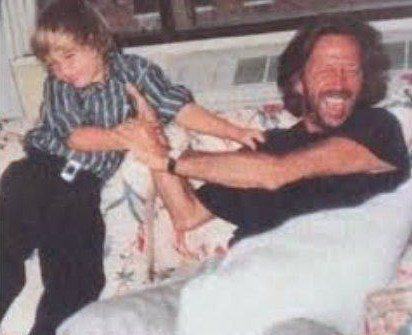
In 1986, his son Conor was born to Italian actress Lory Del Santo. Although Clapton and Del Santo were not in a long-term partnership, they shared a deep devotion to their child. For Clapton, becoming a father brought clarity and purpose. After years spent drifting between stages, studios, and substances, he now felt anchored by something far greater than fame. Conor’s presence offered redemption, a tangible reason to remain sober and emotionally available. The bond between father and son became a source of joy and healing.
Clapton often described how profoundly fatherhood changed him. Simple experiences—reading a story, holding his child’s hand, hearing laughter—took on immense meaning. The chaotic rhythms of touring no longer felt as important as quiet, ordinary moments. For someone who had wrestled with despair, this new chapter represented hope.
Then came the devastating morning in March 1991.
Clapton had planned to spend the day with his four-year-old son, looking forward to a visit to the Bronx Zoo. Conor was staying at his mother’s high-rise apartment in Manhattan. Unknown to the family, maintenance work had left a large window temporarily open after cleaning. In a tragic and unforeseeable sequence of events, the young child ran through the apartment and fell from the 53rd floor. The accident was instantaneous and catastrophic.
When Clapton arrived at the scene, he was confronted with unimaginable horror: emergency vehicles, stunned bystanders, and the irreversible reality that his son was gone. In one moment, the future he had envisioned—school days, shared hobbies, conversations yet to happen—vanished. No amount of prior suffering could have prepared him for this.
The death of a child defies comprehension. It disrupts the natural order of life and challenges the very foundations of identity. For Clapton, grief was not abstract; it was overwhelming and suffocating. Music, once his sanctuary, initially felt inaccessible. Guitars lay untouched. Silence filled his home. The man who had once poured emotion effortlessly into blues riffs found himself unable to translate this magnitude of pain into sound.
Grieving parents often describe a sense of suspended time. Days blur together. Familiar routines feel meaningless. Clapton later spoke about feeling hollow, as though language itself was inadequate. Yet slowly, almost imperceptibly, he returned to music—not as a performer seeking applause, but as a father searching for expression.
Out of this process emerged “Tears in Heaven,” written in collaboration with lyricist Will Jennings. The song did not attempt to dramatize tragedy. Instead, it asked fragile, intimate questions: Would you know my name if I saw you in heaven? Would it be the same? These lines resonated because they articulated what many grieving individuals silently wonder. The lyrics captured longing, uncertainty, and enduring love without bitterness.
In 1992, Clapton performed the song for his acoustic album Unplugged, recorded as part of MTV’s acclaimed series. The stripped-down arrangement allowed vulnerability to take center stage. Listeners around the world connected deeply with the performance. The song went on to receive three Grammy Awards, including Song of the Year. Yet accolades were secondary to its emotional impact. “Tears in Heaven” became an anthem for mourning, offering solace to countless families coping with loss.
For several years, Clapton included the song in nearly every concert setlist. Each performance required him to revisit the rawest chapter of his life. Audiences often sat in hushed silence, aware they were witnessing not just entertainment, but a personal act of remembrance. Eventually, however, he chose to stop performing it regularly. Healing had shifted his relationship to the song. He explained that he no longer felt the acute sense of loss that once fueled each rendition. Allowing the piece to rest was, in its own way, a sign of growth.
Conor’s death permanently altered Clapton’s trajectory. Sobriety transformed from a difficult discipline into a sacred responsibility. Remaining clean was no longer solely about preserving his career or health; it was about honoring his child’s memory. Every sober day became a quiet tribute.
In 1998, he founded the Crossroads Centre in Antigua, a rehabilitation facility dedicated to helping individuals overcome substance dependence. Drawing from his own experiences in recovery, Clapton sought to create a supportive environment where others could reclaim their lives. Through benefit concerts and fundraising efforts, he sustained the center’s mission for decades. Thousands of people have since received treatment there, extending the ripple effect of one family’s tragedy into widespread compassion and assistance.
The establishment of Crossroads represented a profound transformation: grief converted into service. Rather than allowing sorrow to consume him, Clapton channeled it into tangible help for others. This shift did not erase pain, but it provided meaning. Many who have faced devastating loss speak of a similar turning point—the realization that purpose can coexist with heartbreak.
Now in his late seventies, Clapton remains reflective about his journey. He rarely speaks publicly about Conor, but when he does, the emotion is unmistakable. Time has softened certain edges of grief, yet it has not erased it. Parents who have endured comparable loss often describe grief not as something that disappears, but as something that integrates into their identity. It becomes part of the emotional landscape, shaping empathy and perspective.
Clapton’s life today stands in stark contrast to the turbulence of his early career. Nearly four decades of sobriety testify to sustained commitment. He continues to perform selectively and to record music, carrying forward a legacy that spans blues, rock, and acoustic traditions. His playing retains the expressive depth that first captivated audiences, now enriched by lived experience.
“Tears in Heaven” endures as one of the most poignant songs in popular music history. It is played at memorials, shared during moments of remembrance, and discovered anew by younger generations. While deeply personal in origin, its themes are universal. It speaks to anyone who has loved and lost, who has wrestled with questions about connection beyond death, and who seeks comfort in art when words fail.
Conor’s life was heartbreakingly brief—just four years—but his impact radiates outward. Through his father’s transformation, his memory continues to inspire acts of healing and generosity. The song that emerged from tragedy stands as evidence that even the deepest sorrow can give rise to beauty.
Eric Clapton’s story is not solely about fame or musical mastery. It is about survival, accountability, and the enduring power of love. He endured addiction and loss, confronted unimaginable grief, and chose—again and again—to remain present. In doing so, he demonstrated that while tragedy can redefine a life, it does not have to end it.
Love, even when interrupted by fate, leaves an imprint that time cannot erase. Through music, service, and steadfast sobriety, Clapton has ensured that his son’s memory lives on—not only in a song, but in countless lives touched by compassion born from sorrow.