Dogs have lived alongside humans for thousands of years, developing a unique relationship built on trust, companionship, and communication. While humans often rely on language and facial expressions to communicate, dogs experience the world in a very different way. Their primary sense is smell, and it plays a crucial role in how they understand their environment.
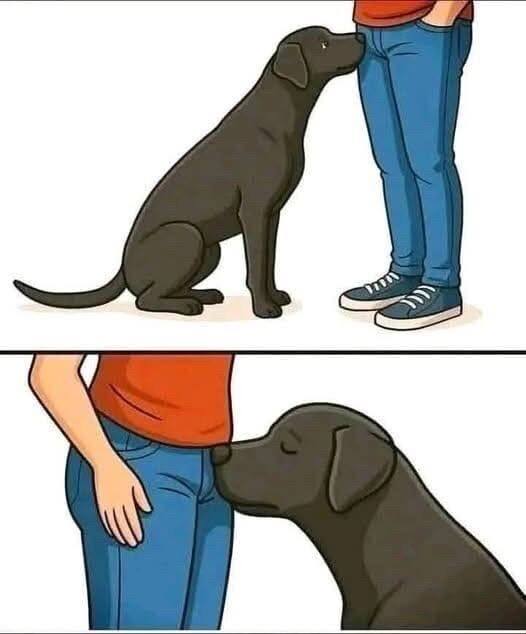
The image above humorously illustrates a situation many dog owners recognize: a dog sniffing a person. While this behavior can sometimes catch people off guard, it is actually a completely natural and normal part of canine behavior.
Understanding why dogs sniff humans can provide valuable insight into how dogs gather information, express curiosity, and build social connections.
The Power of a Dog’s Sense of Smell
Dogs possess an extraordinary sense of smell that far surpasses that of humans. Scientists estimate that a dog’s sense of smell can be 10,000 to 100,000 times more sensitive than a human’s.
This remarkable ability comes from the structure of a dog’s nose. A typical human nose contains around 5 to 6 million scent receptors. In contrast, many dog breeds have over 200 million scent receptors.
Some breeds that specialize in scent detection may have even more.
Because of this powerful sensory system, dogs rely heavily on smell to interpret the world around them.
Smell allows dogs to detect information that humans cannot perceive at all.
Why Dogs Use Smell to Gather Information
When a dog sniffs something, it is essentially collecting data about its surroundings.
Through scent, dogs can identify:
• Other animals that have passed through an area
• The emotional state of a person
• Hormonal changes
• What someone recently ate
• Where someone has been
This ability turns a simple sniff into a complex form of investigation.
To a dog, scent acts almost like a story, revealing details about the environment and the individuals within it.
Why Dogs Sometimes Sniff People Directly
Many dog owners have experienced a moment when a dog approaches and begins sniffing them closely. While this behavior might seem unusual from a human perspective, it is a standard way for dogs to gather information.
Certain areas of the human body produce stronger scent signals due to the presence of sweat glands. These glands release chemical compounds that carry unique scent markers.
Dogs naturally gravitate toward areas where these scents are strongest because they provide the most information.
For dogs, this process is similar to how humans might look at someone’s face to recognize them.
The Role of Scent in Social Interaction
Dogs rely heavily on scent when interacting with other animals as well. When two dogs meet, they often begin by sniffing each other.
This behavior helps them quickly determine important information, including:
• Identity
• Age
• Health
• Mood
• Reproductive status
Because scent plays such a large role in canine communication, dogs may apply the same instinctive behavior when interacting with humans.
It is simply their way of saying hello and gathering information.
The Science Behind Canine Olfaction
The science of how dogs process smells falls within the field of Olfaction, which studies how organisms detect and interpret scent.
Dogs possess a specialized organ called the vomeronasal organ, sometimes referred to as Jacobson’s organ. This structure allows them to detect chemical signals that humans cannot perceive.
These chemical signals can reveal subtle information about hormones, emotions, and biological states.
Because of this advanced sensory system, dogs can often detect changes in a person’s body chemistry that humans themselves may not even notice.
Dogs and Emotional Detection
Research suggests that dogs can also sense human emotions through scent and body language.
For example, dogs may detect changes in sweat or hormone levels associated with stress or fear.
When a person feels anxious, the body releases certain chemicals that alter scent patterns. Dogs may interpret these changes and adjust their behavior accordingly.
This sensitivity is one reason dogs are sometimes used in therapeutic roles, assisting people with anxiety or emotional challenges.
The Importance of Curiosity in Dogs
Dogs are naturally curious animals. Exploring their surroundings through smell is a key part of their behavior.
Just as humans might examine an unfamiliar object visually, dogs investigate the world using their noses.
Sniffing provides them with information about safety, familiarity, and novelty.
A dog that sniffs frequently is simply engaging with its environment in a normal and healthy way.
How Humans Can Respond to This Behavior
Although sniffing is natural for dogs, it can occasionally make people uncomfortable—especially if they are not familiar with canine behavior.
In most cases, the best response is to remain calm and avoid sudden movements. Quick reactions can sometimes startle or confuse a dog.
Allowing the dog a moment to investigate usually satisfies its curiosity.
Owners can also gently redirect their dog’s attention if the behavior becomes excessive.
Training and socialization play important roles in helping dogs learn appropriate ways to interact with people.
Training Dogs for Social Situations
Responsible dog ownership involves teaching dogs how to behave in various environments.
Basic obedience training can help dogs understand when certain behaviors are appropriate and when they should stop.
Commands such as “sit,” “stay,” or “leave it” can help redirect a dog’s focus if necessary.
Training does not eliminate a dog’s natural instincts, but it helps manage them in a way that keeps interactions comfortable for both humans and animals.
Dogs That Work With Their Noses
The extraordinary scent abilities of dogs have led humans to rely on them for many specialized tasks.
Dogs are trained to detect:
• Missing persons
• Illegal substances
• Explosives
• Wildlife tracking
• Medical conditions
One notable application involves dogs trained to detect diseases through scent.
For example, research has shown that some dogs can help detect signs of Cancer or low blood sugar levels in people with diabetes.
These abilities highlight just how powerful a dog’s sense of smell truly is.
Why Dogs Are Drawn to Certain Smells
Dogs may show particular interest in certain scents due to their strength or novelty.
Sweat, perfumes, food odors, and environmental smells can all attract a dog’s attention.
Sometimes dogs are simply curious about something unfamiliar.
Other times they may be reacting to scents associated with other animals.
Understanding this behavior helps people interpret what their dog may be experiencing.
Socialization and Early Experiences
A dog’s behavior around humans is often influenced by its early experiences.
Dogs that are properly socialized during puppyhood tend to feel more comfortable around new people and environments.
Positive interactions during early development help dogs learn appropriate ways to approach strangers.
This process also reduces anxiety and encourages calm behavior during encounters.
The Human–Dog Bond
The relationship between humans and dogs is one of the oldest partnerships in human history.
Dogs were among the first animals domesticated by humans, and over thousands of years they evolved to live alongside us.
This long history has shaped dogs into animals that are highly attuned to human behavior.
Their ability to interpret human cues—combined with their powerful sense of smell—makes them uniquely suited to companionship.
Humor and Internet Culture
Images like the one shown often circulate online because they create humorous misunderstandings.
Visual perspective, camera angles, and timing can produce situations that look different from what they actually represent.
These playful moments often become memes or viral posts.
The humor usually comes from the contrast between the viewer’s first impression and the reality of the situation.
In many cases, the image simply captures an ordinary moment between a dog and its owner.
Understanding Animal Behavior
Learning about animal behavior helps people interpret these situations more accurately.
Dogs are not acting with human intentions when they sniff or investigate something. Instead, they are following instincts that evolved over thousands of years.
Recognizing these instincts allows people to respond appropriately and maintain positive interactions with animals.
Respecting Natural Instincts
Dogs have natural behaviors that are essential to their well-being. Sniffing, exploring, and investigating their surroundings are all part of how they experience the world.
Rather than discouraging these behaviors entirely, responsible owners focus on guiding them in appropriate ways.
Providing dogs with opportunities to explore safely helps satisfy their curiosity and keeps them mentally stimulated.
The Importance of Responsible Pet Ownership
Owning a dog comes with important responsibilities.
Owners should ensure their pets receive proper training, socialization, and exercise.
Regular veterinary care, proper nutrition, and mental stimulation are also essential for maintaining a dog’s health and happiness.
By understanding canine behavior, owners can create environments that support their dog’s natural instincts while maintaining comfortable interactions with others.
Conclusion
Dogs rely on their sense of smell more than any other sense. What may appear unusual or humorous from a human perspective is often simply a dog’s way of exploring and understanding the world.
Sniffing behavior provides dogs with valuable information about their environment, the people around them, and the emotions they encounter.
By recognizing how dogs use scent to communicate and gather information, people can better appreciate the remarkable abilities of these animals.
Ultimately, moments like the one illustrated in the image serve as reminders of how different the canine experience of the world truly is—and how fascinating the relationship between humans and dogs can be.