In an age where digital platforms have the power to elevate even the most ordinary observations into global conversations, it should come as little surprise that a household item as familiar as the bath towel has recently found itself at the center of widespread curiosity. The contemporary internet excels at transforming overlooked details into viral phenomena, prompting millions to pause and reconsider objects they have encountered daily without question. What began as a fleeting moment of curiosity—sparked by a single social media post—evolved into a broader investigation of design, functionality, and the silent intelligence embedded within everyday materials.
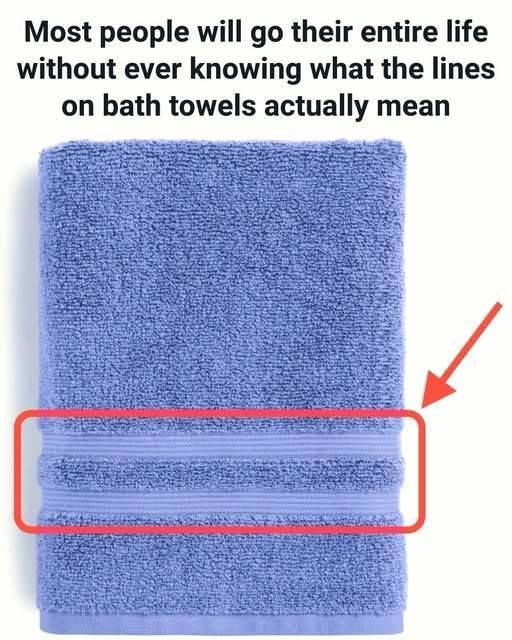
The catalyst for this discussion was neither a scholarly paper nor a design symposium, but a casual post on X (formerly known as Twitter). The post featured a close-up image of a cotton towel, highlighting a narrow, textured band woven across its width near each end. Accompanying the image was a deceptively simple question: What is this line actually for? Within hours, the post had amassed millions of views, triggering a cascade of speculation, humor, and debate. As with most viral mysteries, the responses ranged wildly in both seriousness and creativity. Some commentators proposed practical explanations rooted in personal hygiene, suggesting the line functioned as a divider between sections of the towel designated for different parts of the body. Others offered more fanciful interpretations, joking that the strip acted as a “speed line” to enhance drying efficiency or existed purely as a marketing gimmick meant to convey an illusion of luxury.
While these theories entertained social media audiences, they largely obscured the true purpose of the feature. The textured band, far from being arbitrary or purely decorative, is the result of deliberate engineering decisions refined over centuries of textile production. Known within the industry as a dobby border, this woven strip plays a crucial role in the structural performance, durability, and usability of bath towels. Understanding its purpose requires moving beyond internet folklore and into the realms of textile science, manufacturing technology, and functional design.
Bath towels are subjected to conditions far more demanding than many other household fabrics. They endure repeated exposure to water, friction against the skin, frequent laundering, and high temperatures during drying cycles. Over time, these stresses can compromise a towel’s shape, texture, and integrity. Without reinforcement, the loops that make up terry cloth—the defining feature responsible for absorbency—are particularly vulnerable to distortion and damage. The dobby border addresses this vulnerability by introducing a tightly woven, flat section that stabilizes the towel’s structure.
This border is produced using a specialized machine known as a dobby loom, which allows manufacturers to create dense, geometric weave patterns distinct from the surrounding terry fabric. Unlike the plush loops that dominate the towel’s surface, the dobby border is smooth and compact, offering strength where it is most needed: near the hems. These reinforced sections act as a framework, preventing the edges from unraveling and ensuring the towel retains its rectangular shape over time. In the absence of such reinforcement, towels are prone to uneven shrinkage, curling edges, and the familiar “hourglass” distortion that plagues cheaper products.
The significance of this structural support becomes especially evident after repeated washing. Fabrics expand and contract as they absorb moisture and are exposed to heat, and without a stabilizing element, these changes occur unevenly. The dobby border mitigates this effect by distributing tension more evenly across the towel’s surface. As a result, the towel hangs straight on a rack, folds neatly, and stacks uniformly in storage—qualities that contribute not only to aesthetic appeal but also to long-term usability.
Beyond durability, the dobby border also influences the tactile and functional experience of using a towel. Absorbency, often assumed to be a simple matter of thickness, is in fact a complex balance of material density, airflow, and drying efficiency. A towel composed entirely of dense loops would indeed absorb large amounts of water, but it would also become excessively heavy and slow to dry. Prolonged dampness creates an ideal environment for mildew and odor-causing bacteria, undermining hygiene and shortening the towel’s lifespan.
The flat weave of the dobby border introduces a strategic interruption in loop density, allowing air to circulate more freely when the towel is hung to dry. This design choice reduces overall drying time and helps maintain freshness between uses. In this way, the border exemplifies a principle often seen in effective design: sometimes, removing material or altering texture enhances performance rather than diminishing it. The dobby border demonstrates how subtle variations in structure can significantly improve both comfort and functionality.
Aesthetics and branding represent another important dimension of the dobby border’s role. Because the border is flat and tightly woven, it provides an ideal surface for decorative elements that would be difficult to execute on looped terry fabric. Manufacturers frequently use this area to incorporate jacquard patterns, embroidered logos, or contrasting color accents. In the hospitality industry, such details are not merely ornamental. Hotels often use variations in dobby border patterns to distinguish towel sizes or quality grades, allowing staff to identify linens quickly and efficiently.
For consumers, these visual cues contribute to a sense of order and refinement within the home. The border serves as a natural guide for folding, ensuring consistency in presentation when towels are stored or displayed. What might initially appear as a minor design detail thus plays a role in shaping perceptions of cleanliness, organization, and even luxury. The transformation of an industrial textile into an item of home décor depends in part on these finishing touches.
The viral discussion surrounding the towel border also opened the door to broader conversations about hygiene and domestic routines. As users debated the purpose of the line, many revisited a longstanding question: if one is clean upon exiting the shower, why does a towel eventually become dirty? While the dobby border enhances structural integrity, it cannot prevent the accumulation of dead skin cells, residual soap, and moisture that collectively create a breeding ground for bacteria. Interestingly, the border itself—due to its flat surface—can be one of the first areas where buildup becomes visible if towels are not properly rinsed and dried.
This aspect of the design highlights an often-overlooked benefit of the dobby border: ease of cleaning. The smooth weave is less likely to trap debris than looped fabric, making it easier to inspect and maintain. In this sense, the border contributes indirectly to hygiene by signaling when laundering is necessary and facilitating more thorough cleaning.
At a deeper level, the fascination with the towel border reflects a broader cultural tendency to overlook the sophistication of everyday objects. Modern life is filled with designs that operate quietly in the background, solving problems so effectively that their solutions become invisible. These “silent geniuses” of design rarely attract attention until someone pauses to question their existence. The dobby border is a prime example—a feature refined through generations of textile craftsmanship to address issues of durability, performance, and aesthetics without drawing focus to itself.
The history of weaving is ancient, predating written language and forming the foundation of many civilizations. Techniques such as dobby weaving represent the accumulation of centuries of experimentation and innovation, adapted to modern manufacturing processes. In mass-produced towels, this heritage persists in subtle forms, bridging traditional craftsmanship with contemporary demands for efficiency and consistency. The border is not an afterthought but a continuation of this lineage, embodying the intersection of art, engineering, and domestic utility.
As the online conversation matured, the tone gradually shifted. Initial jokes and speculative theories gave way to a more informed appreciation of the design’s purpose. What began as a source of amusement evolved into a lesson in material science and industrial design. Many participants expressed newfound respect for the engineers and weavers who recognized that such a small detail could dramatically extend a product’s lifespan.
This shift underscores the educational potential of viral moments. While social media is often criticized for superficiality, it can also serve as a gateway to deeper understanding. In this case, a simple question about a towel prompted millions to reconsider how much thought goes into objects they routinely take for granted. The realization that a narrow strip of fabric can determine whether a towel lasts months or years reframes the way we perceive value and quality.
Ultimately, the story of the towel border is about more than textiles. It is a reminder that functionality and beauty are not mutually exclusive, and that thoughtful design often reveals itself in the smallest details. The next time one reaches for a towel after bathing, that textured line may no longer fade into the background. Instead, it can be recognized as a carefully engineered solution—a quiet guardian of structure, hygiene, and order.
Sharing this knowledge is not merely an exercise in trivia; it is an invitation to cultivate awareness of the intelligence embedded in the material world. When we acknowledge the ingenuity behind everyday objects, we develop a greater appreciation for the systems and skills that support daily life. The dobby border, modest though it may appear, stands as a woven testament to human problem-solving—proof that even the simplest household items carry stories of innovation worth telling.