Rising Tensions in the Persian Gulf: Reports of Strikes on U.S. Military Installations
The Persian Gulf region has once again become the center of intense geopolitical attention following reports of military strikes allegedly targeting United States bases across several Gulf countries. According to statements broadcast by Iranian state television and attributed to military sources, Iranian forces launched coordinated operations against American military installations in the Gulf. The reports have triggered heightened security measures across multiple nations, with governments urging residents to remain indoors and avoid areas associated with military infrastructure.
While the situation continues to evolve, early accounts suggest a series of explosions and defensive responses in countries including the United Arab Emirates, Bahrain, Qatar, and Kuwait. Officials in several states have announced temporary airspace closures and activated emergency protocols as a precautionary measure.
Reports of Military Action in the United Arab Emirates
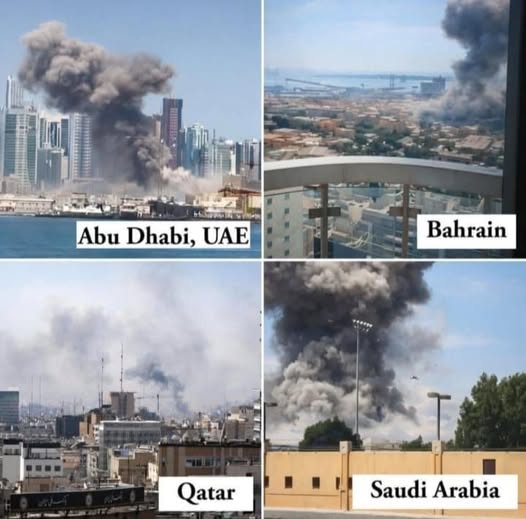
International news agency Reuters cited sources reporting a significant explosion in Abu Dhabi, the capital of the United Arab Emirates (UAE). Although the precise cause of the blast has not yet been independently verified, local authorities moved swiftly to close the country’s airspace as a precaution.
Separate accounts indicate that the Al Dhafra Air Base, located south of Abu Dhabi and known to host U.S. military personnel, may have been targeted. Reports suggest ballistic missiles were used in the alleged strike, resulting in large explosions. However, official confirmation regarding damage or casualties has not been released at the time of reporting.
The UAE government has not provided detailed public statements beyond confirming heightened security measures and temporary flight suspensions. Civil aviation authorities indicated that commercial traffic was halted to ensure public safety while assessments were conducted.
Developments in Bahrain
In Bahrain’s capital, Manama, local observers reported smoke rising in the Al Jufair district. This area is home to facilities used by the United States Navy’s Fifth Fleet. Reports circulating in regional media suggest the smoke followed what was described as an Iranian military action.
Authorities in Bahrain have advised residents to avoid unnecessary travel and to remain inside their homes while security forces evaluate the situation. Emergency response teams were reportedly deployed to assess infrastructure and ensure civilian safety.
As with other reported incidents, independent confirmation of the full scope of the alleged attack remains limited. Officials have emphasized that investigations are ongoing and that further information will be shared once verified.
Qatar Announces Airspace Closure and Defensive Interceptions
Qatar also reported heightened military activity. The country’s Interior Ministry urged residents to shelter in place, citing security concerns related to a potential missile threat. Reports indicate that a Patriot missile defense system was activated to intercept an incoming projectile allegedly aimed at the Al Udeid Air Base, a significant U.S. military installation in the region.
The Qatari Defense Ministry later stated that several attempted strikes had been successfully repelled and that national defense systems were functioning effectively. Authorities confirmed the temporary closure of Qatari airspace as a precaution.
In official statements, Qatari leaders emphasized their commitment to maintaining stability and protecting civilian populations while cooperating with international partners. High alert status remains in effect as security agencies continue monitoring developments.
Reports from Kuwait
According to media coverage from regional outlets, including Al Jazeera, powerful explosions were heard in Kuwait. While detailed information remains limited, authorities advised residents to stay at home and refrain from going to work or public areas until further notice.
Kuwaiti officials have not released specific details about whether military facilities were directly targeted, but they confirmed the implementation of precautionary measures to safeguard public safety. Emergency management teams are reportedly coordinating with regional partners to assess potential risks.
Broader Regional Impact
The reported incidents have sent shockwaves across the Gulf region and beyond. Global markets reacted cautiously as investors monitored the unfolding situation. Energy markets in particular showed signs of volatility due to concerns about potential disruptions to oil production and shipping routes through the Strait of Hormuz, one of the world’s most strategically important maritime corridors.
Airlines rerouted flights to avoid Gulf airspace, while international embassies in the region issued travel advisories urging citizens to remain vigilant. Shipping companies also reviewed navigation routes in response to the uncertainty.
Diplomatic channels have reportedly been activated, with international leaders calling for restraint and de-escalation. Several governments urged all parties to avoid further military confrontation and to pursue dialogue aimed at restoring regional stability.
Historical Context of Tensions
Tensions between Iran and the United States have fluctuated over the years, often intensifying during periods of political or military strain. The Persian Gulf has long been a focal point for strategic competition due to its vital energy resources and critical shipping lanes.
The presence of U.S. military bases across Gulf states is part of long-standing defense agreements intended to deter threats and ensure maritime security. At the same time, Iran has consistently viewed the U.S. military presence in the region as a security concern.
Previous incidents in the Gulf have included missile launches, drone strikes, and maritime confrontations. While many crises have been contained through diplomatic engagement, each episode carries the risk of miscalculation or escalation.
Civilian Safety and Government Advisories
Across the affected countries, government authorities have emphasized that public safety is the top priority. Shelter-in-place advisories were issued in several locations, instructing residents to remain indoors, avoid windows, and follow official updates through verified channels.
Airspace closures were implemented not only to protect civilian aircraft but also to allow defense systems to operate without interference. Schools, workplaces, and public institutions in certain areas were temporarily closed as a precaution.
Emergency response services remain on standby, and hospitals have reportedly activated contingency plans to handle potential casualties, though no confirmed casualty figures have been publicly released.
International Response and Calls for Restraint
Global leaders reacted swiftly to the reports of military action. Several countries issued statements expressing concern about rising tensions and urging restraint. The United Nations called for de-escalation and encouraged all parties to resolve disputes through diplomatic channels.
Energy-importing nations expressed particular concern about the potential impact on global oil supply chains. Analysts note that even short-term instability in the Gulf can influence international markets due to the region’s strategic importance.
Diplomatic discussions are reportedly underway among regional and international actors aimed at preventing further escalation. Experts caution that clear communication between military and political leaders is essential to avoid misunderstandings.
Strategic Importance of the Gulf Region
The Persian Gulf plays a central role in global energy distribution. A significant portion of the world’s oil and natural gas exports pass through the Strait of Hormuz. Any disruption in this corridor can have ripple effects across international economies.
Beyond energy, the region is also a hub for global aviation and maritime trade. Major airports in Doha, Abu Dhabi, Dubai, and Kuwait serve as transit points connecting Europe, Asia, and Africa. Temporary airspace closures therefore have widespread logistical implications.
The Gulf states have invested heavily in advanced defense systems to protect critical infrastructure. Missile interception systems such as the Patriot platform are designed to neutralize aerial threats, though their deployment often signals heightened security concerns.
Information Verification and Media Coverage
As with many rapidly developing international events, information remains fluid. Initial reports often rely on statements from official sources, eyewitness accounts, and media outlets that may not yet have full confirmation.
Independent verification from multiple sources is essential before drawing definitive conclusions about the scope or consequences of the alleged strikes. Governments in the region have urged the public to rely on official channels and avoid spreading unverified rumors.
Media organizations continue to monitor the situation closely, providing updates as more information becomes available.
Economic and Humanitarian Considerations
Beyond military and political implications, any escalation in the Gulf region carries potential humanitarian consequences. Disruptions to infrastructure can affect daily life, commerce, and access to essential services.
Economic uncertainty may influence investment decisions and consumer confidence both regionally and globally. Energy price fluctuations can impact transportation costs, manufacturing, and household budgets worldwide.
Humanitarian organizations are closely watching the situation to ensure readiness should civilian populations require assistance.
The Path Forward
While tensions appear elevated, diplomatic avenues remain open. Historically, many regional crises have been defused through negotiation, back-channel communication, and international mediation.
Observers stress the importance of measured responses and strategic dialogue. Preventing further escalation will likely require coordinated efforts from regional powers, global stakeholders, and multilateral institutions.
In times of uncertainty, accurate information, transparent communication, and adherence to international law play critical roles in maintaining stability.
Conclusion
The reported strikes on U.S. military bases in the Persian Gulf mark a significant development in an already sensitive geopolitical landscape. With airspace closures, defensive interceptions, and emergency advisories issued across multiple countries, the situation underscores the fragility of regional security dynamics.
As investigations continue and official statements evolve, the international community remains focused on preventing further escalation. The coming days will be crucial in determining whether diplomatic engagement can restore calm and reduce the risk of broader conflict.
For now, governments across the region are prioritizing civilian safety while monitoring developments closely. Global attention remains fixed on the Persian Gulf, where stability is closely tied to international economic and political interests.