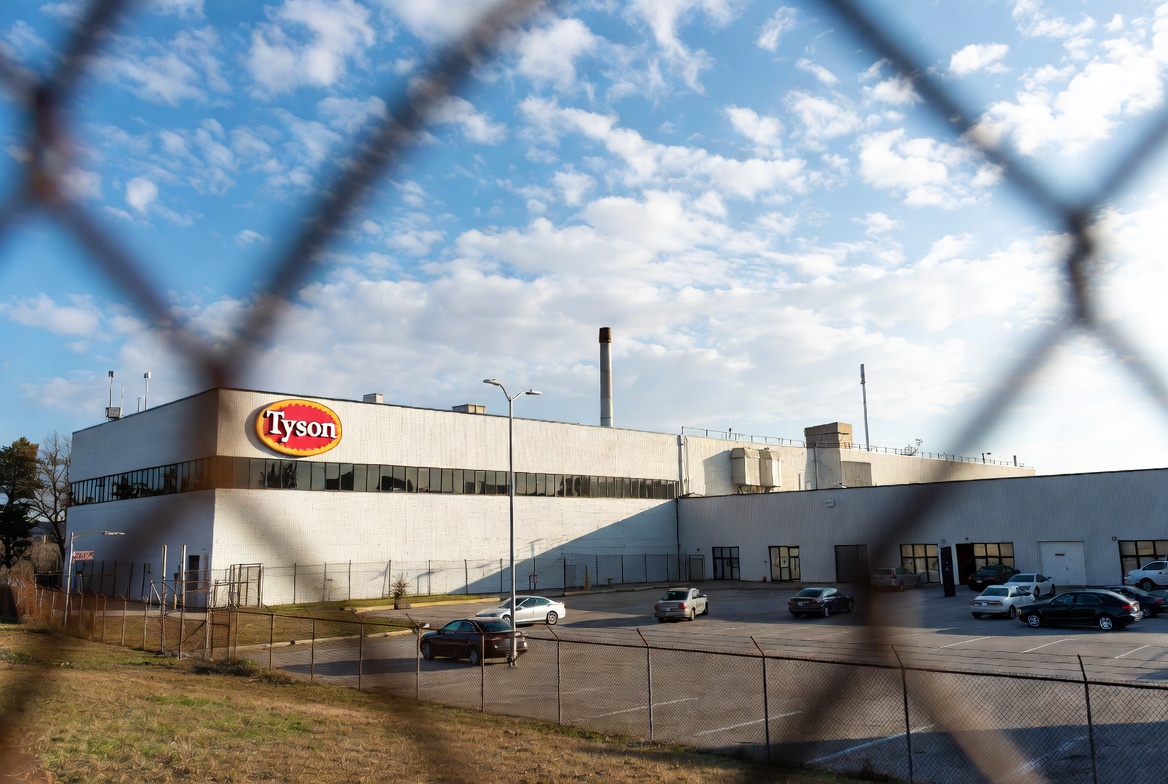
Late in 2025, Tyson Foods announced a major restructuring of its beef processing operations that will significantly affect local communities, cattle markets, and the broader meatpacking industry.
Central to the announcement is the permanent closure of Tyson’s large beef processing facility in Lexington, Nebraska, scheduled for January 20, 2026, along with a reduction to a single shift at another Tyson plant in Amarillo, Texas. Together, these moves are expected to remove roughly 7–9 percent of U.S. beef processing capacity, a notable contraction in an industry already grappling with supply challenges.
According to Wisconsin Public Radio, Tyson described the decision as an effort to “right size” its beef business amid persistent financial pressures and limited cattle supplies.
Economists have been closely monitoring how the closure could impact both cattle producers and consumers. Traditionally, the shutdown of a processing plant leads to lower cattle prices for ranchers and higher beef prices at grocery stores, as processing capacity tightens.
However, livestock economist David Anderson of Texas A&M University suggested this situation may be different. “Typically, when a plant closes, what we expect is lower cattle prices and higher beef prices, because we’ve lost this capacity,” Anderson said. “But at the same time, we’ve got so much excess capacity already that that may not happen. It’s not like the closing has created a constraint on packing.”
That assessment reflects broader conditions across the U.S. beef industry. In 2025, the nation’s cattle herd fell to its smallest size in more than seventy years, driven by prolonged drought, high feed costs, and shrinking profit margins for ranchers.
As a result, many beef processing plants have been operating below full capacity. Nationally, plants were running at just over 81 percent capacity, while the Lexington facility itself was operating at approximately 75 percent, leaving room for other plants to absorb some of the displaced production.
Despite these industry-wide factors, the local consequences of the closure are expected to be severe. The Lexington plant employs more than 3,200 workers, making it the town’s largest employer in a community of just over 10,000 residents.
In comparison, the Amarillo facility — where Tyson is cutting shifts affecting around 1,700 workers — is located in a much larger city with a more diversified economy. Anderson emphasized the disparity, noting, “It’s so difficult to replace an employer of that magnitude. So the rippling effect of this is pretty terrible.”
The closure is also expected to impact cattle producers and feedlot operators in the surrounding region. Without a nearby processing facility, producers may be forced to ship cattle farther distances, increasing transportation costs and shrinking already-thin margins. One local feedlot operator estimated that hauling cattle to more distant plants could add about $20 per head, a significant burden at scale.
Beyond economics, community leaders worry about deeper social consequences. Over the past three decades, Tyson’s presence in Lexington helped shape the town’s demographic and cultural landscape, drawing workers from across the country and abroad.
Many fear that the loss of the plant will lead to population decline as families relocate in search of work. One resident warned that the closure could trigger an “exodus of the immigrant population, just because there won’t be jobs right here in town.”