After my husband died, the quiet in our house became something tangible, something with weight and presence. It pressed down on me like damp wool, settling into corners, clinging to the furniture, embedding itself into the grain of the floor. Silence was no longer simply the absence of sound—it was an entity, a constant reminder that the steady rhythm I had lived by for years had abruptly stopped.
For a long time before his death, our home had not been a place of rest or warmth in the traditional sense. It had become a site of necessity and vigilance. Machines hummed where laughter once lived. The oxygen concentrator wheezed through the night, its mechanical breathing a substitute for my own sleep. Medicine bottles lined the counters, their labels worn from use. Every hour had been measured not by clocks but by symptoms, dosages, and whispered prayers offered in the dark when exhaustion made faith feel thin but desperation made it unavoidable.
I had learned how to sleep without truly sleeping. I balanced myself on the very edge of the mattress so I wouldn’t disturb his weakened body. My ears stayed alert, trained to detect the smallest change in his breathing. Any pause, any hitch, and I would be awake instantly, heart racing, already bracing for the worst. I lived in that heightened state for years, suspended between hope and dread.
When his breathing finally stopped, the stillness that followed wasn’t gentle. It wasn’t peaceful. It was terrifying. The machines went quiet, and in their absence was a void so profound it felt like the air had been sucked out of the room. I realized then that I didn’t know how to exist without listening for him.
The days following his death passed in fragments. The funeral came and went in a haze of sympathetic faces and rehearsed condolences. People brought food that I barely touched, hugged me with careful restraint, and told me I was strong. By evening, they returned to their own homes, where life continued in recognizable patterns. I went back to a house that felt cavernous and unfamiliar.
Grief was heavy enough on its own, but it came paired with something colder and more relentless: financial reality. Medical bills had drained us long before his death. We had sold what little safety net we had accumulated—retirement savings, emergency funds, anything that could be converted into more time. And I would do it all again without hesitation. I would have sold the walls themselves if it had bought us another sunset together. But love, no matter how deep, does not pay property taxes or electric bills.
The house was mine now, legally speaking, but ownership felt hollow. It came with a mortgage that no longer fit my income and maintenance costs that loomed like threats. Every envelope that arrived in the mail felt accusatory. I worked double shifts at the hospital, coming home bone-tired, only to sit at the kitchen table staring at numbers that refused to cooperate.
My stepson, Leo, was nineteen then. He looked so much like his father it sometimes stole my breath. The same strong jaw, the same habit of leaning against doorframes as if the world were something he could handle with ease. Watching him was both comforting and painful. He had been there for everything—the decline, the nights when I came home from work only to begin another unpaid shift as caregiver, the stacks of overdue notices that piled up like evidence of failure.
One evening, when exhaustion stripped away my pride, I asked him to sit with me at the kitchen table. The room smelled faintly of burnt coffee and disinfectant wipes. My hands shook as I wrapped them around my mug, more for stability than warmth.
I told him the truth. I told him I was scared. I told him I couldn’t keep everything afloat on my own. Then I asked—quietly, carefully—if he could contribute five hundred dollars a month to help cover expenses. It wasn’t a demand. It was a plea born from survival.
His reaction blindsided me.
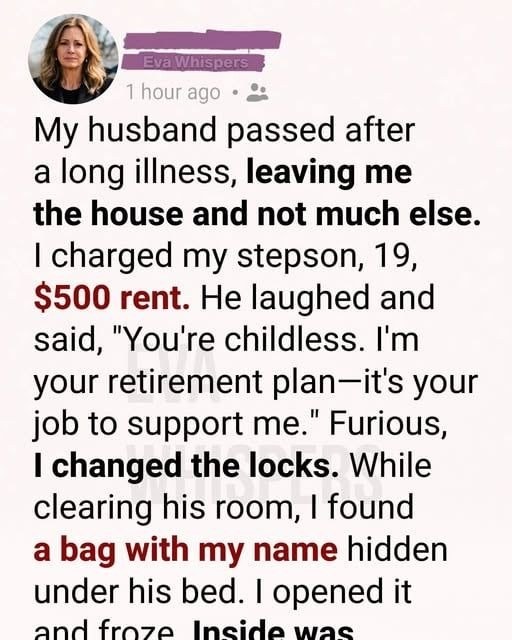
Instead of concern, he leaned back in his chair with a casual ease that felt jarring. A crooked smile crossed his face. Then he laughed—not kindly, not nervously, but dismissively. He said I didn’t have children of my own, so I shouldn’t worry. He told me that meant he was essentially my retirement plan. That supporting him was my responsibility.
The words hit me harder than I expected. “Childless.” As if the years I spent raising him didn’t count. As if the scraped knees, late-night talks, school events, and emotional labor were invisible. I didn’t argue. I didn’t cry in front of him. I simply nodded and excused myself, retreating to my bedroom where I lay awake until morning, watching shadows crawl across the ceiling.
By dawn, something inside me had hardened. Fear and resentment merged into resolve. When Leo left for work that morning, I called a locksmith. Changing the locks felt drastic, but also necessary. If he saw me as a utility rather than a parent, then I needed to protect myself.
I packed his belongings slowly, methodically. Each hoodie I folded carried memories. Each pair of shoes reminded me of the boy who had once run through this house without a care in the world. My chest ached, but I kept going.
While reaching under his bed for a stray sock, my hand brushed against something solid. I pulled out a worn duffel bag, pushed so far back it seemed intentionally hidden. A strip of masking tape was stuck to the zipper. On it, written in his uneven handwriting, was my name.
My heart stuttered.
I opened the bag and found a savings passbook. Page after page showed deposits—small amounts at first, growing over time. Ten dollars. Fifty. A hundred. The dates spanned four years. At the top of the first page were words written with care: Mom’s Future Security Fund.
Behind it was an envelope labeled, “For her birthday—don’t back out this time.”
Inside was a letter.
He wrote about watching me cry alone at night. About seeing me sacrifice everything for his father. About his fear that once his dad was gone, I would be left with nothing. He explained that every dollar he earned went into that account because he wanted to protect me. He wanted me to feel safe.
The comment at the kitchen table hadn’t been cruelty. It had been clumsy humor masking a surprise he was terrified of ruining.
I collapsed onto the floor, the truth crashing over me.
That evening, I waited outside for him. When he arrived, I didn’t bring up money. I handed him the bag and pulled him into a hug that felt like coming home.
For the first time in months, the house felt full again.
Family, I realized, isn’t defined by blood—but by who stands guard when the world goes quiet.