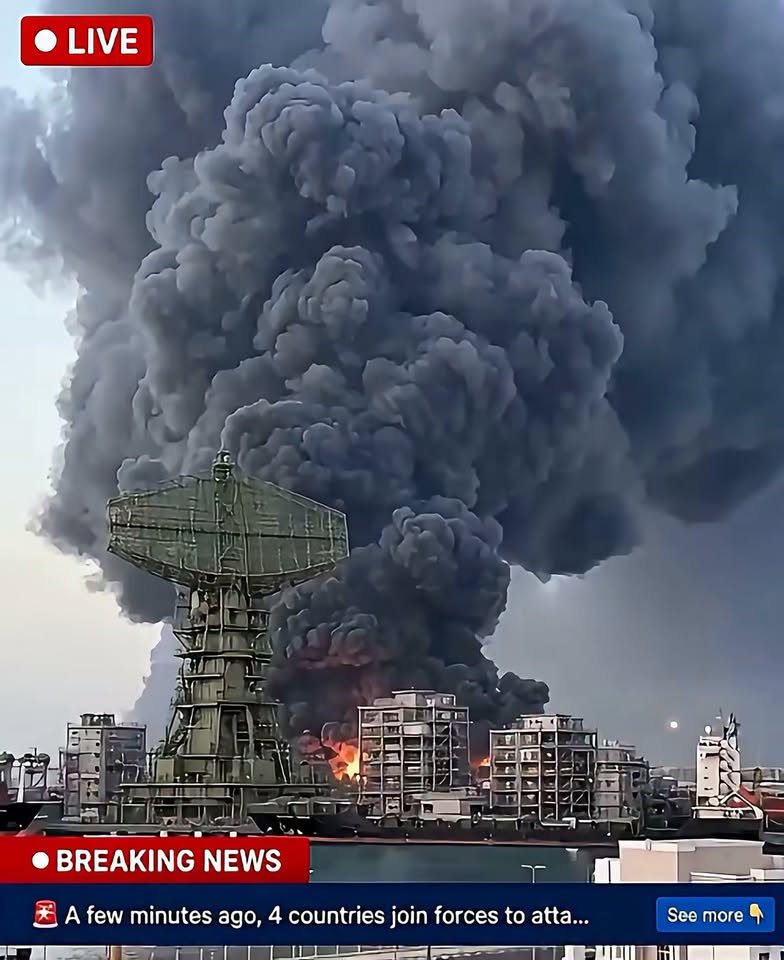
The following article is a fictional geopolitical scenario created for entertainment and storytelling purposes. It does not describe an actual military operation or a verified international event.
In a dramatic fictional development, four countries have reportedly formed an unprecedented military alliance and launched a coordinated operation in response to a growing regional security crisis. The announcement has sent shockwaves through the imagined international community, raising questions about the alliance’s objectives, the possibility of further escalation, and the consequences for global stability.
According to the fictional account, the four governments reached their decision following several days of confidential discussions involving senior political leaders, defense ministers, intelligence officials, and military commanders.
The agreement reportedly established a joint operational framework designed to combine military resources, intelligence capabilities, surveillance systems, and strategic planning.
Although the identities of the participating countries remain undisclosed in this fictional narrative, their decision to cooperate represents a significant turning point in the imagined crisis.
An Unexpected Alliance Changes the Situation
The fictional announcement came after weeks of mounting diplomatic disagreements and growing concerns over regional security.
In this imagined scenario, the four countries had previously maintained separate defense strategies, occasionally cooperating on security matters but never participating in a military initiative of this scale.
That changed when their governments concluded that the developing situation required a unified response.
During emergency meetings, senior officials reportedly examined intelligence assessments, evaluated potential threats, and discussed the consequences of acting independently.
The resulting agreement created a multinational command structure responsible for coordinating military activities and sharing information.
A fictional government spokesperson described the partnership as a necessary response to an increasingly unpredictable security environment.
The statement emphasized that the alliance’s primary objective was to protect national interests, strengthen regional stability, and prevent further deterioration of the situation.
However, the announcement left several important questions unanswered.
What specific threat prompted the operation? How long would the alliance remain active? And could other countries eventually become involved?
Military Forces Begin Coordinated Preparations
Within hours of the fictional announcement, military officials from the four participating countries reportedly began coordinating their resources.
The imagined operation included preparations involving air defense systems, naval surveillance, ground forces, and intelligence-sharing networks.
Military commanders were tasked with establishing reliable communication channels and ensuring that participating units could operate under a common strategic framework.
The fictional alliance also placed particular emphasis on protecting critical infrastructure and monitoring developments near sensitive areas.
According to the scenario, these preparations were intended to demonstrate readiness while avoiding unnecessary confrontation.
Nevertheless, the scale of the coordinated activity attracted international attention.
Defense observers in the fictional world questioned whether the operation would remain limited to deterrence and surveillance or eventually expand into more direct military involvement.
The uncertainty surrounding its objectives contributed to growing concern among neighboring countries.
World Leaders Respond to the Announcement
The fictional military partnership quickly became a major subject of international diplomatic discussion.
Governments outside the alliance reportedly requested additional information about its objectives and potential consequences.
Some leaders welcomed the cooperation as an effort to address shared security concerns.
Others expressed reservations about the possibility that a multinational military operation could increase tensions rather than resolve them.
In the imagined scenario, several governments urged all parties to maintain open diplomatic communication and avoid actions that could trigger a wider confrontation.
International organizations also called for restraint.
Their fictional statements emphasized the importance of peaceful dispute resolution, respect for international law, and protection of civilian populations.
Behind the scenes, diplomats reportedly worked to determine whether negotiations could reduce tensions before the situation escalated further.
Could the Alliance Change the Regional Balance of Power?
One of the most significant questions raised by the fictional development concerns the balance of military and political influence.
When multiple countries coordinate their defense capabilities, their combined resources can create a stronger strategic position than any participant might possess individually.
Shared intelligence may improve situational awareness, while coordinated planning can reduce duplication and improve communication.
However, multinational military partnerships also present challenges.
Each participating government may have different national priorities, political constraints, and expectations about the operation.
Maintaining unity can become difficult when circumstances change or when the costs of continued involvement increase.
In this fictional scenario, analysts suggested that the alliance’s long-term effectiveness would depend on the ability of its members to maintain common objectives.
They also warned that the partnership could prompt other countries to reconsider their own security arrangements.
Growing Concerns About Escalation
Although the fictional alliance described its operation as defensive, the announcement created uncertainty about how other governments might interpret its actions.
Military deployments can sometimes be viewed differently by the countries conducting them and by neighboring states.
A measure intended to demonstrate readiness may be perceived elsewhere as a potential threat.
This difference in interpretation can increase the risk of miscalculation.
Within the imagined crisis, diplomatic observers expressed concern that heightened military activity could lead to misunderstandings, especially if communication between opposing sides became limited.
They urged the participating governments to clarify their intentions and establish procedures for preventing accidental confrontation.
The fictional scenario illustrates a broader principle of international security: military strength and diplomatic communication often need to operate together to reduce the risk of conflict.
Economic Markets React to the Imagined Crisis
The consequences of the fictional announcement extended beyond military and political discussions.
In the imagined world, financial markets responded cautiously as investors assessed the possibility of a prolonged regional crisis.
Energy prices became a particular focus because international tensions can affect expectations about transportation routes, production, and supply chains.
Businesses with operations near the fictional conflict area began reviewing contingency plans.
Shipping companies considered alternative routes, while international corporations evaluated potential disruptions.
Economic analysts in the scenario warned that prolonged uncertainty could discourage investment and increase costs for consumers.
However, they also emphasized that the scale of any economic impact would depend on whether the military operation developed into a broader confrontation.
Civilians Face an Uncertain Future
While government officials debated strategic objectives, the fictional crisis also raised concerns about ordinary people.
Families living near sensitive areas worried about the possibility of military escalation.
Local authorities began reviewing emergency preparedness procedures, while humanitarian organizations considered how they might respond if the situation deteriorated.
The fictional narrative highlights how geopolitical decisions can affect communities far removed from government meeting rooms.
Even without direct fighting, uncertainty can influence daily routines, economic confidence, and people’s sense of security.
In this imagined scenario, humanitarian representatives called on all parties to prioritize civilian protection and preserve access to essential services.
Their message was straightforward: whatever political disagreements exist, the safety of ordinary people must remain a central concern.
What Happens if More Countries Become Involved?
Another major question in the fictional crisis concerns whether the four-country alliance could expand.
Multinational security arrangements sometimes attract interest from governments that share similar concerns.
Additional participation could strengthen the alliance’s resources and political influence.
However, expansion might also complicate decision-making and increase tensions with countries that oppose the operation.
In the imagined scenario, several governments were reportedly monitoring developments before deciding whether to offer diplomatic or logistical support.
No additional participants had been confirmed within the fictional account.
Analysts suggested that the next phase would depend heavily on the alliance’s actions and the responses of other regional powers.
Diplomacy Remains a Possible Path Forward
Despite the military preparations, the fictional narrative leaves room for a diplomatic resolution.
Representatives from several governments reportedly encouraged negotiations aimed at addressing the security concerns that led to the alliance’s formation.
Potential discussions could involve confidence-building measures, communication agreements, and independent monitoring arrangements.
Such steps might help reduce uncertainty and prevent the crisis from developing into a wider conflict.
In the fictional scenario, officials acknowledged that military coordination alone could not resolve every political disagreement.
A lasting settlement would require communication, compromise, and a willingness to address underlying concerns.
The World Watches What Comes Next
As the fictional four-country operation enters its next phase, several important questions remain unanswered.
The participating governments have not disclosed the full extent of their plans within the story.
The duration of the operation remains uncertain, and the possibility of additional international involvement continues to generate discussion.
For the imagined international community, the coming days could determine whether the alliance becomes a lasting security partnership or a temporary response to an extraordinary situation.
The central question is no longer simply why four nations decided to stand together, but whether their unprecedented cooperation will lead to greater stability or create new challenges for international security.
For now, the fictional world remains focused on the next announcement, the next diplomatic meeting, and the next decision by the countries involved.
This article is entirely fictional. The military alliance, announcements, diplomatic reactions, and operational developments described above are invented and should not be presented as real-world news.