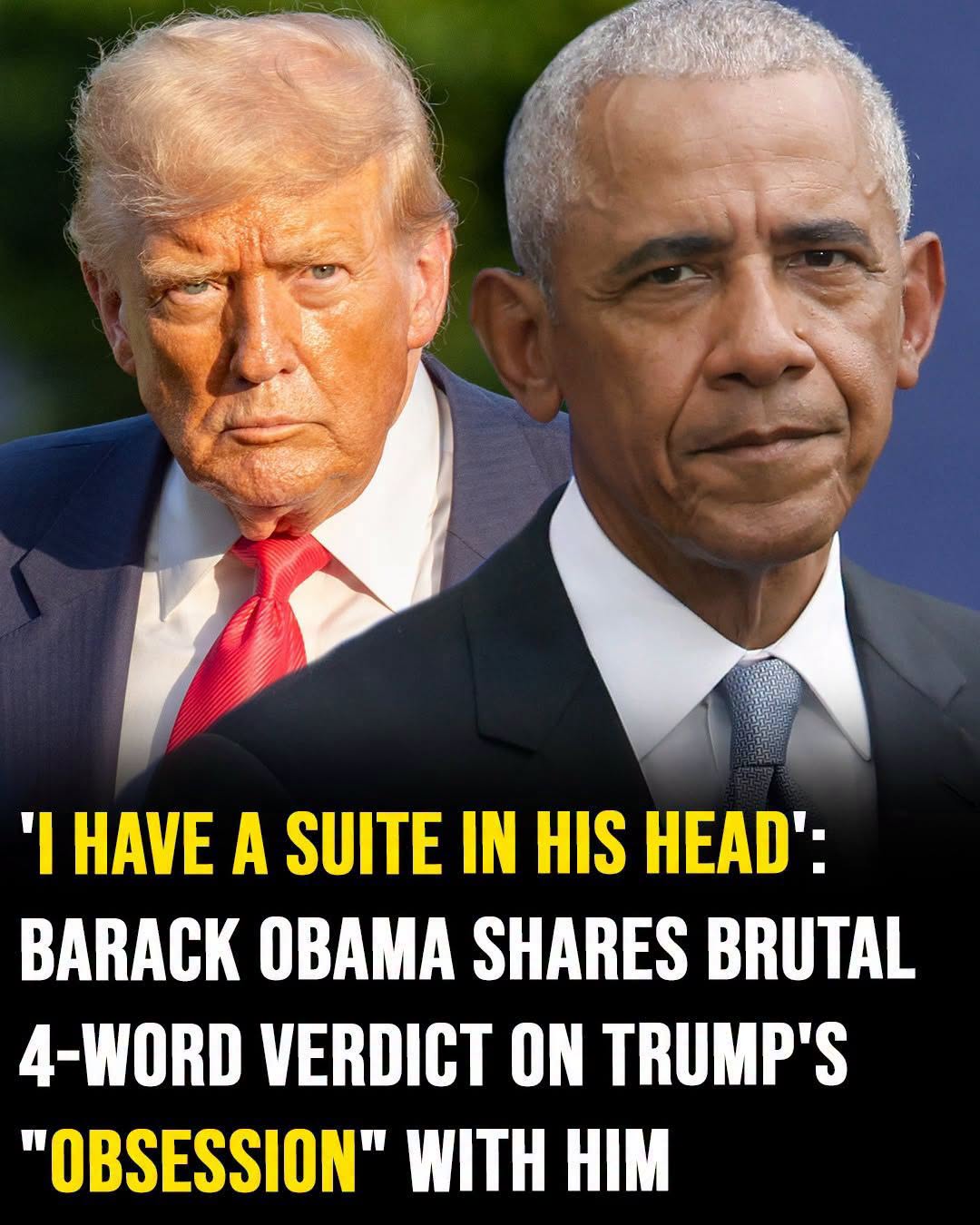
For years, Donald Trump has frequently mentioned Barack Obama in speeches, interviews, campaign rallies, and social media posts.
From policy disagreements to personal criticism, Obama has remained a recurring subject in Trump’s public remarks long after both men left office.
For much of that time, Obama largely avoided responding directly.
Instead, he generally focused on broader political issues and rarely engaged in personal exchanges.
That is why recent comments from the former president attracted so much attention.
Appearing on a podcast, Obama addressed the years of criticism in a way many listeners described as calm, measured, and unmistakably pointed.
Rather than delivering an emotional rebuttal, he approached the subject with humor and observation.
Without dwelling on specific insults or lengthy arguments, Obama suggested that Trump’s repeated references to him reflected something larger than ordinary political disagreement.
At one point, Obama joked that he occupies considerable space in Trump’s thoughts.
“I’ve got a room,” he quipped before adding that it might actually be “a suite.”
The audience laughed, but the comment carried a deeper message.
Obama implied that Trump’s continued focus on his predecessor says less about Obama’s presidency and more about Trump’s own political priorities.
His remarks quickly spread across television, podcasts, news outlets, and social media, where supporters and critics alike debated their meaning.
Some viewed the comments as one of Obama’s sharpest public responses to Trump in years.
Others saw them as an example of his familiar style—using humor rather than anger to make a political point.
The discussion soon moved beyond the joke itself.
Obama went on to draw a contrast between his own experience in office and what he believes presidential leadership should require.
Reflecting on his presidency, he said that thinking constantly about the administration that came before him was never a priority.
His attention, he explained, was focused on governing, addressing current challenges, and making decisions affecting the American people.
His point was straightforward.
In his view, effective leadership requires looking ahead rather than remaining preoccupied with political rivals or predecessors.
Although he never needed to mention Trump by name repeatedly, the comparison was widely understood by listeners.
For many observers, that comparison became the central message of the interview.
Rather than defending his own legacy point by point, Obama questioned whether continual focus on previous administrations distracts leaders from the responsibilities of governing.
Political analysts noted that the exchange reflects a rivalry that has shaped American politics for more than a decade.
Trump and Obama represent sharply different political philosophies, leadership styles, and visions for the country.
Their disagreements have extended beyond policy into questions of governing, communication, and public leadership.
As a result, even relatively brief comments from either figure often generate significant public attention.
Supporters of Obama praised the remarks as restrained and effective.
Many argued that he avoided personal attacks while making a broader observation about political leadership and priorities.
They suggested his comments reflected confidence rather than confrontation.
Others interpreted the remarks differently.
Some Trump supporters dismissed the comments as political theater, arguing that both parties frequently criticize their predecessors and opponents.
They contended that political rivalry is hardly unique in modern American politics and questioned whether Obama’s observations deserved the level of attention they received.
The differing reactions highlighted how deeply divided political audiences often interpret the same statements.
For one group, the interview represented a thoughtful critique of leadership.
For another, it reflected another chapter in a long-running political rivalry.
Media commentators also pointed out the communication styles of the two former presidents.
Trump is widely known for direct confrontation, memorable nicknames, and frequent criticism of political opponents.
Obama, by contrast, has generally adopted a more measured public tone, often using humor, irony, or indirect observations rather than direct personal attacks.
Those contrasting approaches have become defining characteristics of both men throughout their political careers.
The podcast comments fit neatly within that pattern.
Rather than escalating the rhetoric, Obama relied on understatement.
His most widely quoted line was not an accusation but a joke.
Yet many observers felt the humor carried a pointed criticism beneath the surface.
Beyond the exchange itself, the discussion raised broader questions about presidential leadership and political communication.
Should former presidents respond directly to criticism from successors?
How much attention should current and former leaders devote to political rivals?
And how do ongoing personal conflicts influence public confidence in government?
These questions have become increasingly prominent as American political discourse has grown more polarized.
The interview also reminded many viewers that former presidents continue shaping political conversations long after leaving office.
Although Obama no longer holds elected office, his comments continue to attract significant national attention, particularly when discussing issues involving leadership, democracy, and public service.
Whether one agrees with his assessment or not, his remarks ensured that the broader conversation extended far beyond a single podcast episode.
Ultimately, the interview became about more than two political figures exchanging criticism.
It became part of a larger discussion about leadership, priorities, and the expectations Americans place on those who seek the nation’s highest office.
For some, Obama’s comments served as a reminder that governing requires focusing on future challenges rather than past rivalries.
For others, they represented another moment in an ongoing political rivalry that continues to shape American public life.
Either way, the conversation demonstrated once again that even years after leaving the White House, both Barack Obama and Donald Trump remain among the most influential—and closely watched—voices in American politics.
Their words continue to spark debate, shape headlines, and fuel discussions about the direction of the country, proving that the political relationship between the two former presidents remains one of the defining dynamics of modern American public life.