At eighteen, life feels like a doorway opening into something vast and limitless. It is an age filled with urgency, ambition, and the quiet but powerful belief that everything important lies ahead. For me, that belief came with a decision that would shape the course of my life in ways I could not have imagined.
I left home.
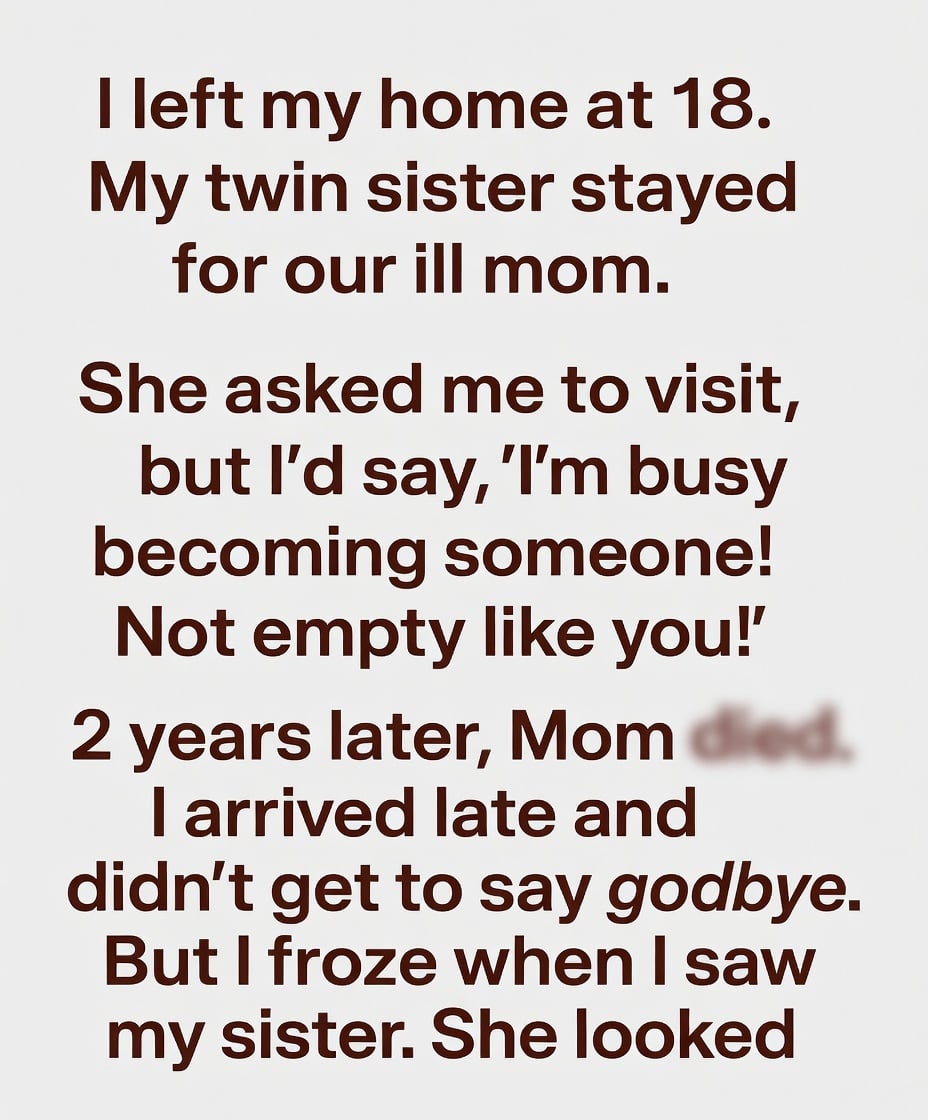
It wasn’t a dramatic escape or a moment fueled by anger. It was, in my mind, a step toward becoming someone—someone independent, successful, and recognized. I wanted to build a life that felt bigger than the small routines I had always known. I wanted to prove something, not just to the world, but to myself.
But leaving meant more than just packing a suitcase and stepping out the door. It meant leaving behind my family—especially my twin sister.
We had grown up side by side, sharing everything from childhood memories to silent understandings that only twins seem to have. We were alike in many ways, but as we reached adulthood, our paths began to diverge.
When our mother fell ill, that difference became impossible to ignore.
While I was planning my future, dreaming of opportunities and chasing ambitions, my sister made a different choice. She stayed.
She stayed to care for our mother.
At the time, I told myself that it made sense. One of us had to remain, and she had chosen that role. I convinced myself that I was not abandoning my responsibilities—I was simply pursuing a different kind of duty, one that would eventually benefit us all.
But deep down, there was a quiet discomfort I tried to ignore.
My sister would call me often in those early months. At first, our conversations were easy, familiar. She would update me on our mother’s condition, talk about small things happening at home, and ask about my new life.
Then, slowly, her tone began to change.
She would ask me to visit.
“Just for a few days,” she would say. “Mom would really like to see you.”
Each time, I had an answer ready.
“I’m busy.”
“I have deadlines.”
“I can’t take time off right now.”
And eventually, the words became sharper, more defensive, as if I needed to justify not just my absence, but my entire choice.
“I’m trying to build something,” I told her once. “I’m becoming someone. I can’t just drop everything.”
It was meant as an explanation, but it came out as something else entirely.
There was a pause on the other end of the line, one that lingered longer than usual.
After that, our conversations grew shorter.
Less frequent.
More distant.
Still, I kept moving forward. My days were filled with work, goals, and the constant push to achieve more. I measured my progress in milestones—promotions, projects completed, recognition earned.
From the outside, everything seemed to be going exactly as planned.
But life doesn’t pause while you chase it.
Back home, time was moving too.
My mother’s condition was changing.
My sister was carrying more weight than I ever truly acknowledged.
And the distance between us—physical and emotional—was growing wider with every passing day.
Two years went by faster than I expected.
Then came the call.
It was early in the morning, a time when unexpected phone calls rarely bring good news. I remember staring at the screen for a moment before answering, as if I already knew what I would hear.
My sister’s voice was quiet.
Our mother had passed away.
There are moments in life when everything else falls away, when time seems to stop, and you are left alone with a single, overwhelming reality.
That was one of those moments.
I don’t remember much about the hours that followed. Packing, traveling, moving—it all blurred together into a sequence of actions without emotion.
But one thought kept repeating in my mind:
I was too late.
When I arrived, the house felt smaller than I remembered. Or maybe it was just emptier.
The familiar spaces carried a silence that was heavier than anything I had ever experienced. Every corner held memories, but none of them could bring back what had been lost.
People were gathered, offering quiet condolences, sharing stories, speaking in soft voices. I nodded, responded when necessary, but I felt disconnected from it all.
Then I saw my sister.
For a moment, I didn’t recognize her.
Not because she had changed in appearance, but because something deeper had shifted. There was a stillness in her, a quiet strength that hadn’t been there before. At the same time, there was a weariness that seemed to reach beyond physical exhaustion.
She had been there for everything.
The long days.
The difficult nights.
The small moments that mattered more than anything else.
And I had missed them all.
As I stood there, looking at her, a wave of realization came over me—not sudden, but heavy, like something that had been building for a long time and had finally reached the surface.
All the reasons I had given.
All the times I had said I was too busy.
All the moments I had postponed.
None of them mattered now.
I had told myself I was becoming someone important.
But in the process, I had distanced myself from the people who had always been there.
The people who had known me before any ambition, before any success.
The people who had simply loved me for who I was.
I approached my sister slowly, unsure of what to say. There are situations where words feel inadequate, where no apology seems sufficient.
“I’m sorry,” I said, finally.
It was a simple phrase, but it carried everything I hadn’t said before.
She looked at me for a moment, her expression unreadable. Then she nodded—not in forgiveness, not in dismissal, but in acknowledgment.
We stood there in silence.
In that moment, I understood something that had taken me years to realize:
Success is not measured only by what you achieve, but by what you choose not to lose along the way.
Ambition can drive you forward, but it can also create distance if you’re not careful.
Time, once gone, does not return.
And the opportunities to be present—to show up, to care, to connect—are far more fragile than we often believe.
In the days that followed, I stayed longer than I had planned.
Not because I had suddenly found the time, but because I finally understood its value.
My sister and I talked—not just about what had happened, but about everything we had left unsaid. It wasn’t easy. There were moments of tension, of sadness, of reflection.
But there was also something else.
A quiet rebuilding.
A recognition that while we couldn’t change the past, we could choose how we moved forward.
I began to see her differently—not just as my twin, but as someone who had carried a responsibility I had avoided. Someone who had shown a kind of strength that doesn’t seek recognition, but deserves it nonetheless.
And I began to see myself more clearly too.
Not just as the person I had tried to become, but as the person I had been—and the choices I had made along the way.
Life continued, as it always does.
I returned to my work, to my routines, to the path I had chosen. But something had shifted.
I called more often.
I visited when I could.
I made space—not just for obligations, but for relationships.
Because I had learned, in the hardest way possible, that being “busy” is not the same as being fulfilled.
And becoming “someone” means very little if you lose connection with the people who mattered from the beginning.
The distance we create in pursuit of our goals can feel necessary, even justified.
But it is worth asking, from time to time:
What are we leaving behind?
And is it worth the cost?
In the end, life is not only about the milestones we reach, but about the moments we share—and the people we choose to share them with.
Some opportunities come once and never return.
Some words remain unspoken forever.
But every day still offers a choice.
To reach out.
To show up.
To be present.
And sometimes, that choice makes all the difference.